Saturday, June 15, 2019

Thrift Store CD Players for Red Book Aficionados

Multi-bit CD players

When I started using and hacking Dynakit tube equipment, they were about 25 years old on average. During that same time frame, I bought my first CD player which was fitted with the Philips cutting-edge TDA1541 16-bit DAC chip. 

Saturday, June 1, 2019

My FM Tuners


Last February I mentioned being distracted by my favorite FM stations in metro Philly. Here are the tuners I've been tuning with. 😉

Vacuum Tube


Sherwood S-3000-II

This mono FM tuner courtesy of J-Rob got me started exploring the airwaves of the area. It blends perfectly with the mono hi-fi installation in our mid-century-modern themed living room. Aside from MCM aesthetics, it made me realize that there are a couple of noteworthy FM stations in our area, which inspired me to restore my out of commission FM MPX tuners and acquire a few more.😉

Scott LT110B

I acquired this tuner from Angela Instruments while working there as a tech in the early 90s. It was later aligned and tweaked in the workbench of the late Tom Cadawas. When it started having issues pulling stations a couple of years ago, I boxed it up. I recently unearthed it and traced the issue to a cracked solder joint in the antenna terminals. This tuner is the most modern sounding of the three tube tuners - tonally reminiscent of the Yamaha T-2, but with narrower stereo separation.

Dyna FM3

This Dyna FM3 factory-wired sample died during my sojourn in Manila. I discovered that each section of the quad filter capacitor all read "0" uf! After replacing the quad capacitor it performed back to factory specs - darker in timbre than the Scott, similar tonal balance to the Sherwood. A tube lover's delight!

Solid State


Yamaha T-2

Back in the early 80s, I bought my NAD 3020 from a fellow in the NYC metro area who was listening to WNCN on this tuner. It left an indelible mark in my memory since I never thought FM broadcasts could sound that good! Alas, I couldn't afford it then, so when I found this at a flea market, I grabbed it! Radio X Tuners (highly recommended) tweaked it to equal or exceed factory specs. It lacks the tube warmth in the midrange but goes deep in the low frequencies with extended and airy highs. Stereo separation is superior to any of the FM tuners in this survey.

Kenwood KT80

I remember seeing this KT80 tuner with its matching KA80 integrated amp at a closeout sale back in the early 80s at Harvey Electronics' West 45th store in NYC. Slim-line was the fashion statement of the era. It may be a notch below the Yamaha T-2 sonically, but still very listenable.

NAD 4300

I got this NAD 4300 tuner because of the AM section, which, unfortunately, is unlistenable! However, the FM section is pretty good. It sounds at par with the KT80, if not better, in the frequency extremes but not quite in the T-2 class. It offers 8 presets + a tuning knob, which almost feels like a true weighted knob/dial string assembly.

Kenwood KT880D

I almost didn't take the KT880D seriously due to its late 80s digital age/jet black/slim-line styling + modern comforts of preset buttons, auto tuning, etc. My ears can't get attuned to the dry and analytical sound. But I'm keeping this (or not?) because it pulls in the most stations and does the best job of squelching FM background noise/hiss.

Coda


Stellar Labs 30-2435 Omni

All the tests were done using either of these two antennas. The Stellar Labs Omni is mounted on a mic stand while the Winegard HD6010 is in the garage attic. I haven't tried them outdoors because I'm afraid of heights. 😆 

If we play the numbers game, the S-3000-II, LT-110B and FM-3 are no match in terms of sensitivity, selectivity and stereo separation (note: the Sherwood is mono) compared to any of the solid state designs above. Even when properly aligned, tube tuners are prone to drifting. However, tube tuners offer fatigue-free listening and FM background hiss and birdies are a lot easier to psycho-acoustically tune out.

All these tuners would have been obsolete if I didn't live in a metropolis that still offered quality FM broadcasts. Here's to my favorite local FM stations: WRTI, WPRB and WXPN! 🍻🍻🍻


Friday, May 17, 2019

A visit to J-Rob's and the Silbatone 755A box by Dr. Stefano Bae

OB/755A


Despite the fact that Joe Roberts and I both revere the 755A, he never thought highly of my open baffle set-up. To this day, I'm still baffled as to why he featured my home-brewer article in Sound Practices. 😉 I enjoy the engulfing planar-like airiness of the 755A/OB combo which Joe finds lifeless, boring and lacking in snap. 

Friday, May 3, 2019

First Philippine Triode Festival June 15-16, 2019

Makati City, Philippines

Featuring a G.I.P. Laboratory + Harana Audio collaboration

GIP 597A field coil high frequency horn

GIP CH-65 midrange horn + GIP 555W field coil compression driver

GIP 815 = 15" field coil woofer loaded in Harana Audio V-Vent II bass cabinets

+

Flea-powered triode amplifiers built by Filipino enthusiasts and guests from our Southeast Asian neighbors.


The Enablers


more info


Wednesday, April 17, 2019

Hashimoto H-203S from Kasuga Wireless

In September 2018, I lamented the demise of Noguchi Transformers. Fast forward to November, my brother-in-law visited Tokyo, and was kind enough to pick up a couple of transformers at Kasuga Wireless.


How to get to Kasuga Wireless

Kasuga Wireless

Address: 1F, New Akihabara Center, 1-16-10, Kotobuki, Chiyoda-ku, Tokyo 101-0021

Hashimoto H-203S


The H203S was installed as a 3.5k primary Z output transformer in the je2a3 mono integrated amp. 


Testing

Top trace = audio generator
Bottom trace = amplifier output

100Hz

1kHz

10kHz

5.324Vrms to an 8 ohm load = 3.5W 

In the past, I've used Hashimoto transformers for a pair of SE2A3 and a pair of SE10 mono-blocks I built for friends. I know these transformers are well designed, are of high quality construction and sound excellent. Thus, before Hashimoto ceases production, I had to add it to my collection. 


My mono SE2A3 integrated is ready for prime time!


Now I have to find a nice circuit for a pair of Kasuga KA6625ST OPTs. 😉


Tuesday, March 19, 2019

Ikea Knarrevik


Ikea Knarrevik 

I use it as:

component stand

turntable stand

speaker stand

Best $10 I ever spent on Hi-Fi! 😉


Tuesday, March 5, 2019

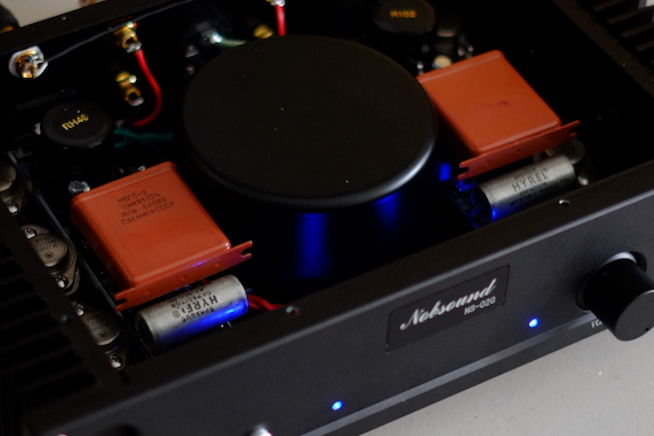
John Linsley-Hood 1969 Class A Amplifier aka Nobsound NS-02g

Original JLH1969 Class A amp schematic

The John Linsley-Hood 1969 Class A amplifier circuit is a classic solid state design that is carefully studied by audio designers. Even the great Nelson Pass revisited this circuit when he embarked on low wattage amplifier designs.

It has been described as one of the most tube sounding solid state amplifier designs, which is not surprising since John Linsley-Hood's references were tube amplifiers. Here's a link to the 1969 article published by Wireless World.


Since I am a DIYer at heart, I originally considered buying a pair of these circuit boards on eBay. But when I spotted a built unit for $170/shipped, I calculated that by the time I factored in the cost of a power transformer and a massive heat sinked chassis, it didn't seem wise or cost effective to go the DIY route.


The JLH 1969 Class A clone I got is branded Nobsound NS-02g but I've seen the same chassis and guts in silver or gold sporting a Krell logo!


It is very compact- a hair over 13" wide x 8.25" deep and 3" high- but it weighs 12 lbs. due to the heavy gauge chassis, massive heatsinks and power transformer. Parts quality is surprising for a $200 amplifier requiring discrete components. Input impedance is set by an Alps Blue Velvet 10k Ohm logarithmic potentiometer. There are no IC chips in this amp, just a couple pairs of transistors, a handful of resistors and capacitors + a lot of copper wire wound in the toroidal transformer. This is a true Class A design from the late 60s built at the end of the second decade of the 21st century.


When I first fired up the amplifier, I heard a buzz when the input level control was at maximum. I traced this to the IEC socket which was not grounded. Strapping the center pin (green cloth insulated wire) to ground took care of the buzz.


!!!WARNING!!! 
The voltages in this circuit are potentially lethal! Proceed at your own risk!


Set Up and Adjustments

NOTE: Red probe to test point, black probe to chassis ground

Idle Current


Out of the box, the amp sounded pleasant but I was not hearing anything magical. I was suspicious of the meager 0.5 amp AC current draw at 120V I monitored on my GenRad Variac. So removed the top cover to study the circuit and determine the purpose of the two potentiometers on each channel's PC board. 

The pot towards the middle of the PC board is for idle current adjustment. Since I didn't have a manual and couldn't find one on-line, I took the cue from this video by a JLH 1969 Class A kit amp builder.👍 His circuit board looked similar enough, thus, the proper voltage must be closer to about 20V(?). I measured 26.5V and 26.2V on my unit. So I turned the pot clockwise until I got about 24 volts DC on both channels. The AC current draw was now over 1 amp and I started feeling heat emanating from the chassis. 

AC Balance


The next step was to adjust AC balance. I loaded each channel's output with an 8 ohm, 20W wire wound resistor and then injected a 1 kHz sine wave at the input jacks. I adjusted the AC balance pots on both channels while observing the clipping behavior closely for best symmetry - both phases of the trace should "square off" simultaneously.


Tweaking the idle current

137℉ @ the heatsink

I checked the idle current once more and listened. 26V yielded almost 10 watts per channel on the bench but I felt the sound can be sweeter. At 21.5V the amp sounded excellent. But the chassis was running physically too hot. Just to be conservative, I backed off a bit and actually found the sweet spot between 22V - 24V. I also made sure there's always ample ventilation around the amp.  

On the Test Bench

Top trace = signal generator
Bottom trace = amp output

100Hz

1kHz

10kHz

Not perfect, but nice and clean square waves from a half a century old solid-state design


Input sensitivity = .25 Vrms > ~ 6.8 watts per channel rms into an 8 ohm load with both channels driven

Tweaks


A slight glare in the upper midrange was ameliorated when I by-passed the 2.2uf input capacitors with 0.47uf Vitamin Q "Hyrel" PIOs and the 2500uf output capacitors with 10uf KBGs. Before reassembly, I also replaced the red LED pilot lights with blue LEDs. Much easier on the eyes especially in a dimly lit room.


 The Nobsound clone amp spent most of its time in the system above, driving a pair of Altec 755Cs in 618 cabinets and also a pair of moderately efficient Radio Shack LX4s. I also listened to it in the main system driving the Altec 2-way. In both cases it never failed to sound sweet, fatigue-free, with a tube-like quality and depth in the midrange, maybe not the tightest bass but definition was good + airy highs.


The only time it betrayed its solid-state identity was when I spun an LP of Shostakovich Symphony No. 11 in the main system. It went into nasty clipping during orchestral peaks like a typical solid-state amp. Maybe it was asking too much from a Class A amp with a measly 7 watts rms per side to cope with the 16 ohm load presented by the Altec 2-way? However, with the same piece and on the same speaker system, my 4 watt per channel Stereo SE2A3dx with Tango NY15s went into overload with grace and composure at a similar SPL.


It is a testament to John Linsley-Hood's engineering and hearing abilities that his 50-year-old circuit is still a very capable music maker. Even if it can't replace any of the tube amplifiers in my collection, this is a much more listenable amplifier than the handful of contemporary Class D switching amps I've heard thus far.


Friday, February 15, 2019

Altec 32 Horn Nomenclature

This Altec 32 horn update was prompted by this must read article from Electravolt tracing how the Altec 32 horn evolved from the Western Electric 32A.

Altec 32A

Cast aluminum + longer throat