
Showing posts with label High-Fidelity. Show all posts
Showing posts with label High-Fidelity. Show all posts
Saturday, November 15, 2025

Saturday, January 11, 2025
Graybar Electric Company

The Graybar Building is a landmarked art deco structure on 420 Lexington Ave., NYC. It was once the corporate headquarters of Graybar Electric Company They distributed the Western Electric 755A, 756A, 728B wide range drivers, 753C, 757A studio monitor speakers + more, which inspired projects featured in this blog.


Wednesday, November 16, 2022
Snell Type JIII Finale - Sensitive Enough?

With the foam issue out of the way, it's time to wrap this up!
Monday, August 1, 2022
OJAS @ Lisson Gallery NYC
Our dear friends Charito and Joey, whom we haven't seen for over five years, were in NYC visiting for a couple of days. On short notice, Tish was able to take a day off so we were able to meet up with them. Joey is an avid audio DIYer and was a frequent collaborator especially during the annual November Hifi Show when I was still based in Manila. He represents G.I.P. Laboratory in the Philippines.

It was also timely that Devon (OJAS) Turnbull's HiFi Dream Listening Room No. 1 exhibit at the Lisson Gallery NYC was on its penultimate week. So Joey and I agreed that this was going to be our meeting place!

Friday, May 6, 2022
Snell Type JIII Part 2: $25 foam vs $40 Euro foam

Re-foaming the 8" woofer found in various incarnations of the Type E, J and K Snell speakers is a very contentious issue exacerbated by their cult-like status amongst audiophile admirers.
 |
| Vifa M21WN-07-04 woofer Left = $25/pr. foam (yellowish tint), Right = $40/pr. Euro foam |
In this day and age of marketing hype, spending $100 or so to import a pair of alleged original foam from European sources is, IMHO, not justifiable. How does one determine which retailer is being truthful?
Given that I wanted to give this project my best shot, when I noticed that Simply Speakers* added a Euro version to their website for $40 a pair/shipped, I placed an order. This is just one of the many reasons why this installment has been delayed.
*No affiliation, just a satisfied customer!
WARNING!
In Part 1, I re-foamed my pair of Vifa M21WN-07-04 woofers using the $25 foam kit. I specifically mentioned that the dust cap and cone are just one piece.
I've seen discussions in audio forums suggesting the removal of the dust cap to center the voice coil. I have to reiterate that the removal of the dust cap = a DESTROYED woofer!
After using both these foam kits, I can confirm that the voice coil on this particular Vifa woofer is self-centering. If you encounter voice coil problems, it's either the foam you used is suspect or you seriously deviated from the instructions.
RTA Traces
$25 foam vs. $40 Euro foam
Only one Vifa M21WN-07-04 was fitted with the Euro foam so I could compare them.
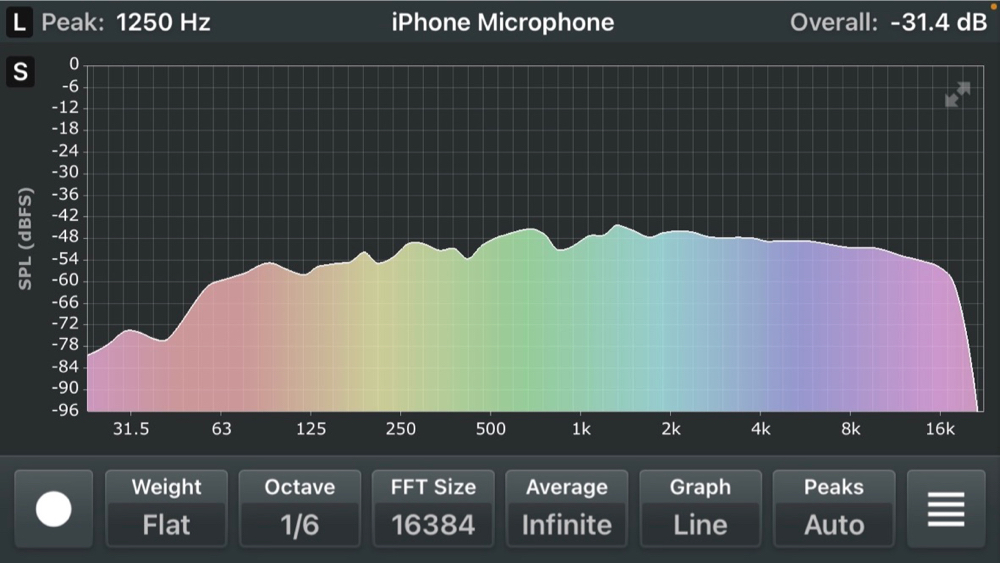
Die-hard Snell aficionados and "specialist" retailers contend that "generic foam" will kill the bass response of the Vifa M21 woofer. Given the RTA traces below, which foam is generic?
 |
| Snell JIII with Simply Speakers $25 foam |
This trace pretty much tracks the original specs at hifiengine.com.
 |
| Snell JIII with Simply Speakers $40 Euro foam |
If we split hairs, this $40 Euro foam trace looks just a touch more ragged.
 |
| Euro foam serial number |
FWIW, unlike the $25 foam, the Euro foam has a serial number. Does that give it more credibility?
Listening to Foam
$25 foam vs. $40 Euro foam
Evaluations were conducted in full dimensional mono!
The sonic dissimilarity was very subtle. It only became obvious in A/B comparisons in which I was consciously listening for a difference. Also, as usual in audio, better metrics don't necessarily = better sound because audio tests (in this case, pink noise) are static while music is very dynamic!

Listening to Billie, Ella, Julie, Frank, Tony and Johnny H, it was relatively easy to discern better midrange presence from the unit fitted with the Euro foam. When I pulled out my Ray Brown, Curtis Counce, Charlie Haden and Mingus CDs and LPs, I heard more tuneful and articulate bass lines from the Euro foamed woofer. The woofer with the $25 foam had a tendency to sound boomy while the midrange was just a touch veiled.
That said, if your Vifa M21s are already fitted with the $25 foam replacement and you're not very DIY savvy, it's nothing to lose sleep over. IMHO, you're still listening to a pair of very decent classic speakers. However, if you're a seasoned DIYer restoring an unmolested pair of Type Js or Es with rotten Vifa foams, go for the $40 Euro foam!
Is the $40 Euro foam the original foam?
 |
| The Time Tunnel |
I wish I could travel back to the early 90s to find the honest-to-goodness truth.
Instead of worrying about matters beyond my control, I'm going to replace the $25 foam on the other Vifa M21 with Euro foam so I can listen in full dimensional stereo!
Tuesday, December 21, 2021
Happy Holidays 2021
With the blessing of Early Bender of Hifitown.com, I uploaded two articles written in the 1980s for The Absolute Sound by his parents, Walt Bender (1944-2008) and Lennice Werth.
 |
| WE/Altec 755A is in Part I |
 |
| Berning EA230 is in Part II |
Olden Golden Components Part II
I've owned quite a few of the components discussed and still listen to a couple. This is a reflection of the articles' profound influence on my pursuit of the audio hobby. Since I believe that they are as relevant then as they are now, I added them to the JE Labs Arkiv.
2021 Index
February: Happy Birthday Mommy + Happy Birthday Daddy
September: DKL and Exacta mount lenses & Exa camera + Budget SUTs - Sony HA-T10 vs. Shure mic transformers
December: JE Labs Man Cave 2021 + Holiday Greetings/2021 Index

As the year comes to a close, I'd like to thank all the visitors, especially those who've contributed to this blog.😊
Wishing everyone a great Holiday Season and all the best in the New Year!
Monday, November 8, 2021
Tube Rolling Fun (and Peril) + Adapters

Tube rolling is a fun aspect of the audio hobby. It only gets tedious when audiophiles start splitting hairs about a VT231, 5692, etc. I draw the line when an audiophool claims, "...my line stage preamp resolves the R train rumble under Carnegie Hall better when I use a 6AS7 in place of the original 6SN7..." 🙄
Those two tubes may be pin compatible BUT a power transformer 🔥melt-down🔥is imminent since the 6AS7/6080 draws 2.5 amps @ 6.3V. That's over 4 times more filament current drawn by a 6SN7, which only draws 0.6 amps @ 6.3V.
💣 💣 💣 Rolling tubes is dangerous unless you have a working knowledge of electronics to comprehend tube data/specs. 💣 💣 💣

It's been a while since I listened through Telefunken 12AX7 smooth plates on an RCA phono. Since I used to graft this circuit on a Dyna PAS preamp, I ordered a pair of 12AU7/12AX7 > 6SN7/6SL7 adapters to relive the experience on my RCA octal preamp.

Back in the 90s, Steve @ Angela Instruments had a boatload of Raytheon 5755s and shared a sleeve with me. Since I never found a project requiring these tubes, I got a pair of 5755/WE420 > 12AX7 adapters to listen to them in the Shure M65 clone. Piggy-backed to 12AX7>6SL7 adapters, they also worked nicely with the octal phono preamp.
Despite slight differences in transconductance and plate impedance between the 6SL7/7F7 and their younger 9-pin siblings (ECC83, 12AD7, 5751 and 5755), there was no visible variation in square waves nor frequency response aberration when I bench tested those tubes in both circuits.

Admittedly, loctals don't look as glamorous as their octal cousins with bakelite bases. But I'm very fond of them to the extent that I built and use a full function loctal preamp. I've been adopting unloved loctals at radio shows and hamfests. Essentially the industrial looking 7F7 and 7N7 are rebased 6SL7 and 6SN7, respectively! My only issue with loctals is, the tube pins are prone to corrosion. This is easily remedied by a wire brush + DeoxIT before use.

I purchased these tube adapters from the seller xulingmrs. They are very well made and fairly priced. Shipping cost and transit time from China was also reasonable. Highly recommended!
Thursday, September 23, 2021

Friday, July 2, 2021
Old Flame - Rogers LS3/5A

As I mentioned in my reply to a reader's query in Snell Type J III, Part 1, I'm the temporary caretaker of a pair of 15 ohm Rogers LS3/5As while my buddy Jose's basement is getting sorted.
 |
| ca. '93 |
Long time readers know that I was a BBC LS3/5A user. A pair of 15 ohm Rogers replaced my Magnepan SMGas in '86. As a partner in a company that distributed Spendor speakers in the Philippines in the early 90s, I also owned a pair of 11 ohm bi-wireable Spendors.
 |
| ca. '94 |
In the preceding two pictures, my pair of DIY PP2A3 monoblocks struggled to drive the Spendors in my tiny apartment. Despite that, the BBC near field monitor opened my ears to the virtues of directly heated triodes. Alas, they were superseded by Altec 755s because I needed more efficient speakers to pursue flea-powered single ended directly heated triode (SE DHT) amps.
The Bextrene cone KEF B110 5" woofer + the complex crossover/EQ network = 82 dB/1W/1M, very inefficient! But kudos to BBC engineers, IME, the speaker is still a relatively easy load for low-powered tube amplifiers because of its high(ish) impedance across the audio band.

Just as I remembered, the LS3/5As are very capable of portraying the midrange magic of an SE300B or even an SE2A3 at near field distances. However, to get some boogie factor out of them, they need the power output of at least a Dyna ST35. But as good as the ST35 amp is, a catch-22 situation ensues because it sounds veiled compared to the aforementioned SE DHT amps.
 |
| Snell Type J III + Rogers LS3/5A |
I was viewing the past through rose-tinted glasses when I posted (#3) in HiFi Haven - mea culpa! There's a greater similarity in tonal character between the Rogers LS3/5A and Snell Type J III. The Altec sound is another entity altogether!

Given my post SE amp/High Efficiency transducer expectations, the Altec 755As in Dr. Bae/Silbatone cabinets are tonally more lifelike across the audio band, offers better resolution, has more low frequency extension, greater micro and macro dynamics and plays at higher SPLs in a package that's not significantly larger.

Listening to the LS3/5As was like seeing a former flame. The familiarity is there but the chemistry and fireworks are gone. (◞‸◟)ノ
Saturday, June 5, 2021
morrison micro 2A3, reimagined + Kasuga Wireless KA6625ST output transformer

Joe Roberts' piece, "I Never Met a 2A3 Amp That I Didn't Like," from Sound Practices Issue 15, is very persuasive. I built jc morrison’s micro 2A3 amp soon after I received the issue via snail mail fresh from the printers in the mid '90s. After rereading the article in ‘07, I got inspired to make a Radiotron SE2A3 variant.
Saturday, April 17, 2021
Marcel Breuer Designed House + Altec 604C + Infinite Baffle

This beautiful mid century modern home aka the Snower residence was designed by Bauhaus architect Marcel Breuer and posted by midcenturyhome, whose finely curated photostream I follow on Instagram.
Saturday, April 3, 2021
Lar Retro-resto Shure M65 Phono Preamp
 |
| Hamingredient inspired chassis 😉 |
In the early 2000s, I tried to unload a half dozen or so of my used/test good Telefunken 12AX7s on eBay. The buyer promptly requested for a return claiming that they didn't test well in his TV-7. Was that a sign...? 😉
So instead of re-listing, I stashed them away. I had forgotten about their existence until they showed up during a 2020 lockdown clean-up spree.
 |
| Shure M65 |
I met my buddy Lar through Audiomart in the late '80s. He's a trained sound engineer and audio hobbyist who shares my passion for the classic Austin Mini.👍 We hang out and talk shop at ham radio festivals, audio and radio shows. He's firmly committed to tube phono circuits employing active RIAA EQ and posts his projects at Audiokarma and Lenco Heaven.
 |
| Shure M65 schematic |
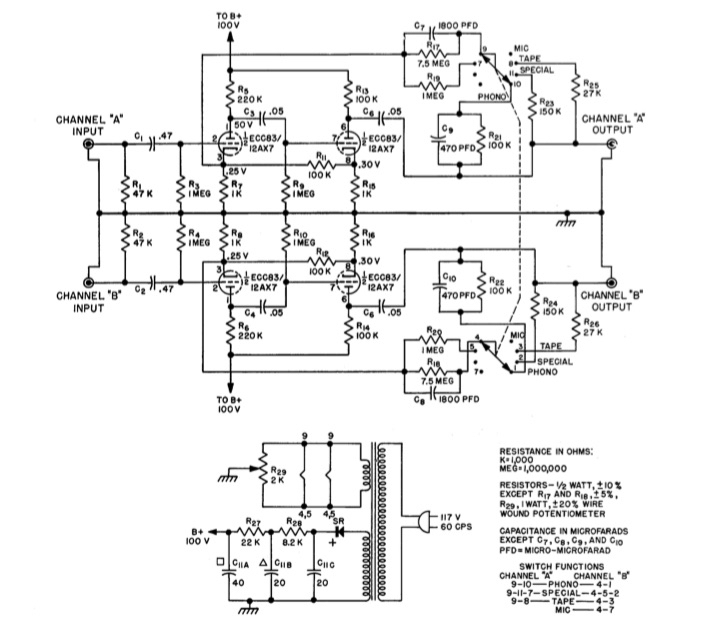
The classic Shure M65 "chrome cutie" (as Lar fondly calls them) is one of his favorite platforms for modification. Keen eyes will notice the similarity of this topology to the phono section of the classic Dynaco PAM-1 and PAS-2/3 tube preamps, albeit operated at a lower B+ voltage and with AC heated filaments.
 |
| One channel shown |
The 0.47uf ceramic disc input coupling caps, C1 and C2 + the 1M shunt resistors, R3 and R4 are discarded. Likewise, the 100k positive feedback resistors (R11 and R12) are eliminated, which I also used to do to my Dyna PAS preamp hacks. IME, this procedure improves transparency. The most significant performance upgrade is Lar's recomputed RIAA EQ capacitor values (see the above schematic) tweaked for flatter response.
I didn't have a Shure M65 but had enough parts to clone one so I could put my rediscovered Tele 12AX7s into good use in the midst of Covid-19 lockdown.

This one chassis configuration sounded fine on first turn on but had an annoying low level hum I couldn't eradicate.

After trying all possible grounding schemes, I yanked the power transformer out and built an outboard power supply. Problem solved!

My power supply is slightly more sophisticated than the stock M65. The full wave rectified B+ is filtered by a 20H/20mA choke followed by a 47uf/450V cap, which splits to separate left and right channel rails with additional decoupling and filtering. The tube filaments are DC heated.
 |
| 1 kHz stock RIAA EQ |
Using the stock RIAA EQ capacitor values, lower frequencies sound bloated with a noticeable treble boost as noted in the Shure M65 literature, which is also visible in the above 1 kHz square wave.
 |
| 1 kHz LAR modified RIAA EQ |
The 1 kHz square wave is squarer and the phono preamp sounds so much better with Lar's tweaked cap values!
I don't think I was ever able to derive this level of musical satisfaction from any of my past 12AX7 phono efforts using active RIAA EQ. I believe the sonic purity stems from the simplicity of the circuit itself. The Dynaco PAM-1 and PAS-2/3 circuits have an additional cap after the negative feedback RIAA EQ tap + elaborate switching and a balance control in the PAS, all of which can cause veiling.
In spite of the Shure 5000 ohm output impedance spec, this is still a relatively high output Z device. When connected directly to the 10k ohm input of my Nobsound NS-02g amp, the loss of extension at both frequency extremes was discernible. It sounded best driving a 100k ohm load using low capacitance cables, 3 ft. long, max!

This phono preamp synergized very well with my favorite magnetic cartridges with conical stylus - Nagaoka MP10, Pickering XV15, Shure M3D and M7D, amongst others. So after a couple of months of enjoying the Lar mod M65, I decided to build it on a nicer (if a bit cramped 😁) cast aluminum box with two pairs of inputs.
Instead of boring you with audiophile adjectives, I'll just say that my RCA passive RIAA EQ octal sounds effortless and airy, while the EAR 834P derived loctal is detailed and dynamic and the Lar retro-resto Shure M65 is sweet and alluring!

This phono preamp is a most welcome addition to my tools for enjoying LP reproduction. I highly recommend following Lar's phono preamp adventures at Audiokarma!
Bravo Lar!👏
Friday, March 19, 2021
Snell Type JIII Part 1 - Deconstructed > Re-Foam
In the late 80s, I could have gotten a Snell Type E or J after unloading my Magnepan SMGas. But I loved the sound of EMI and Decca recordings, for which I give credit to BBC-trained sound engineers, so I invested in a pair of Quad ESL57s and Rogers LS3/5As instead. I was such an Anglophile that I even became a partner in a company that imported Art Audio Amplifiers and Spendor Speakers to the Philippines. Unfortunately, we didn't make money...but that's another story.🤣

During a moment of nostalgia, I chanced upon this pair of Snell JIIIs online. I messaged the seller expressing interest. After two weeks of silence, I made a polite follow-up and was surprised to receive a reply that they were still available. According to the seller, he's had several offers from tire-kicking flippers but he chose to sell to me because I sounded like an enthusiast who'd give them a good home.😄

Typical of speakers from this era, the foam surrounds have disintegrated. Other than that, this is a very clean pair with consecutive serial numbers just like when they were sold in high-end audio salons in the late 80s to early 90s.

While waiting for the replacement foam surrounds, I thoroughly cleaned all vestiges of old foam from the cone and speaker frame. This was the most tedious and time consuming step in the re-foaming process but essential for a successful result!
Meanwhile, I also took advantage of the down time to analyze what makes this speaker system tick.
Deconstruction
Peter Snell was a very gifted speaker designer. Due to his untimely demise at age 38 in 1984, speaker models that were manufactured during his lifetime have developed a following. Peter Qvortrop of Audio Note UK was a big fan of the 2-way Type E, J and K models and continues their legacy in the Audio Note E, J and K using custom drivers and boutique parts.
The Snell E and J had front mounted reflex ports while the K was a sealed box/acoustic suspension design, which employed a different woofer. A rear firing 3/4" dome tweeter was added to the EII model, while the reflex port was moved to the back of the cabinet in both the EII and JII.
 |
| Vifa D26TG-05-006 |
The EIII, JIII and KII designation denotes the switch from a Tonegen 1" doped silk dome tweeter to the Vifa D26TG-05-006 6 ohm 1" dome pictured above. A tweeter level control was also added on all models.
According to the Snell Type JIII brochure, the Vifa D26 tweeter handles an octave of upper midrange frequencies from 2.7kHz + another two octaves of harmonic overtones.

Even if the JIII was manufactured posthumously, it retains the cabinet dimensions and proportions of the original model. After many years of experimenting with open baffles, Altec 614 and 618 and cabinets, I'm a firm believer in the acoustic superiority of Rubenesque front baffles over Victoria's Secret slim waifs.😆

Was the use of plywood (top, bottom and sides) + chipboard (front baffle and back panel) chosen for acoustic reasons? Regardless, the cabinet is of pretty high quality construction with particular attention placed on rigidity - see the brace from the front baffle to the back panel in the picture below.

Good quality air core inductors, electrolytic and film capacitors or a combination of both + an L-pad for tweeter level adjustment were used in the crossover network.

The high-pass is a straightforward 12 dB/octave 2nd order slope hinged at 2.7kHz, as previously mentioned. On the other unit, there was an additional electrolytic cap in the high-pass section with a higher total capacitance reading. This confirms Snell's claim of matching their units to within +/- 0.2dB based on a reference model in their factory.
Likewise, the low-pass section is also a 2nd order slope + an EQ/contour network for the Vifa woofer (see the LCR combo highlighted in red above). Explaining how this EQ works is beyond my technical ability. My empirical mind just knows that it "shapes" the woofer's frequency response. A similar, albeit more complex, crossover + EQ can be found in the BBC LS3/5A.
Since all the capacitors measured close to their indicated values, there was no rationale to change or upgrade. Besides, I want to hear these speakers as close to how they were originally designed.
 |
| Vifa 8" M21WN-07-04 |
AFAIK, the Vifa 8" M21WN-07-04 was the only woofer used in the J, JII and JIII. Based on the 49Hz-20kHz +/- frequency response specified in the JIII brochure, and cross-referenced to my Musical Instrument Frequency Chart, this drive unit/cabinet combo was tasked to cover six and a half octaves of musical information starting from the bass frequencies up to midrange fundamentals.
Re-Foam
After judiciously sifting through audio sites on the net, I chose the $25/pr. foam surrounds from Simply Speakers because they were recommended by audio hobbyists who exhibited good ears and common sense. Check their re-foaming video for a straightforward and confidence-inspiring tutorial.

The Vifa M21 voice coil is essentially self-centering. So don't even consider cutting or removing the dust-cap to shim the voice coil. It'll be ruined because the cone + dust cap is one whole piece.

Not bad for a first attempt in replacing foam surrounds, huh? 😉
Since time immemorial, I've been evaluating drivers bare naked (or mounted in a simple baffle) to hear their potential. After 25 years of enjoying Altecs, these drivers sound very different...🤔
 |
| Snell JIII in room RTA (Onyx iPhone app) Snell JIII specs |
I have to live with this speaker system for a while and play lots of tunes 🎻♫🎶♬🎺and will report back in Part 2!😊

Subscribe to:
Posts (Atom)