Thursday, September 3, 2020

Cheap Thrills from Radio Shack + more

It's been three years since I blogged about Radio Shack's demise. I miss browsing at a Rat Shack store even more.😞 Through the years, a number of audio products from the Radio Shack Catalog  have caught the attention of budget-conscious Hi-Fi enthusiasts. 

I've already covered the 40-1354A 5.25" full-range driver and 40-1310 super tweeter in a previous entry. Below are capsule reviews of a few more Radio Shack audio goodies I've played with. Aside from the cool historical factor, IMHO, most can still equal or even outperform many entry-level audio gear today.


Realistic Pro 30 Headphones
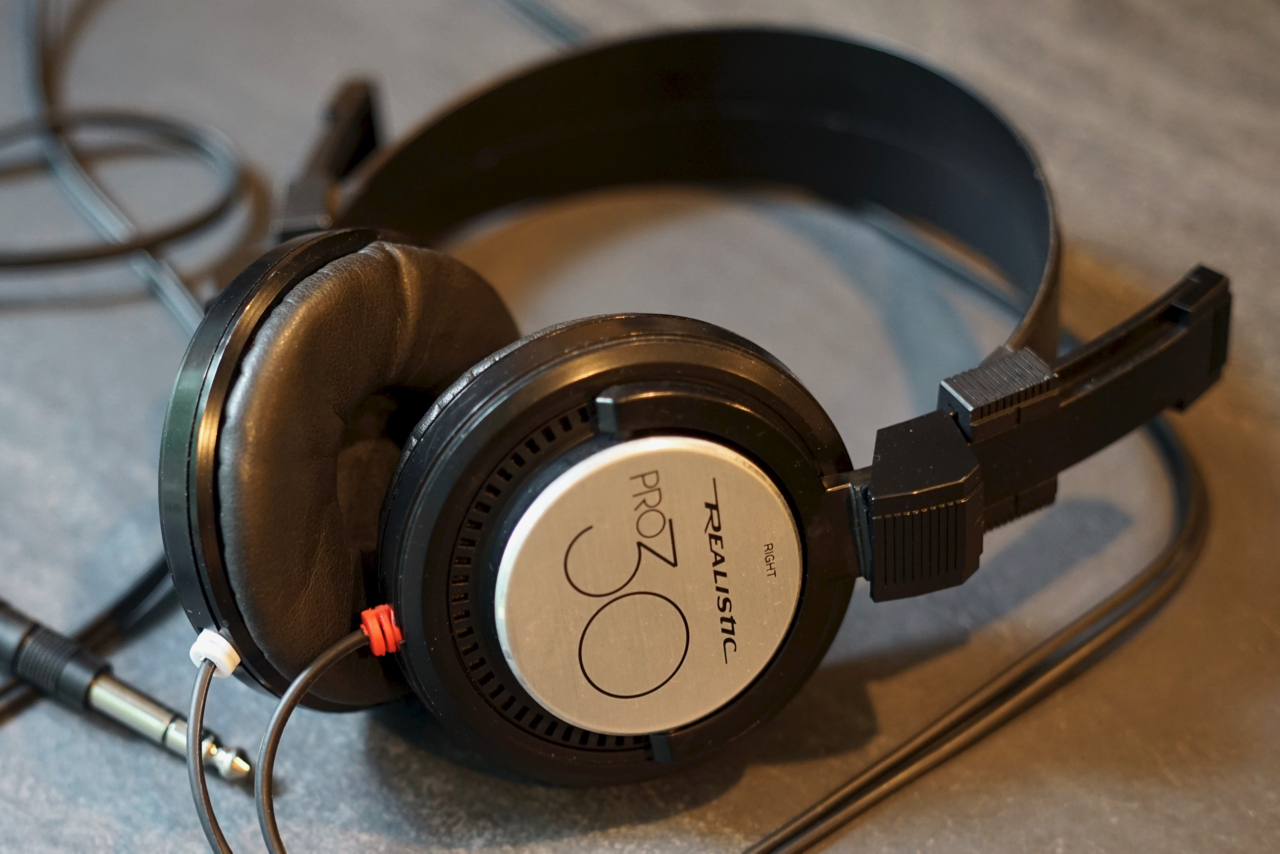


The Realistic Pro 30 was introduced in 1981 for $39.95. Its price was reduced to $34.95 in 1983 and then to $29.95 in 1984. It made its final appearance in the 1986 Catalog. Instead of the usual dynamic drivers, these headphones were fitted with planar magnetic drivers, very unusual at this price point then and now.

It was one of the favorites in the orthodynamic round up thread started by wualta in headfi.org 15 years ago.


I got this pair very cheap because it needed new cables. In stock form, it sounds very smooth and refined. It can be tailored to 21st century tastes via judicious damping. The felt dot boosts high frequencies while the additional felt pad focuses the audio band a bit. New ear pads can improve the bass response since the flattened originals are no longer giving a good seal. Yup, speaker tweaks are applicable to headphones too!

Even if this is still a work in progress, I already prefer the sound of my modified Pro 30 to my Grado SR80. If you're patient, these turn up for around $30/shipped on eBay. 


32-1100A Stereo Mixer


I never got into DJ'ing/mixing but I couldn't resist this Stereo Mixer at a flea market for a couple of bills. It can be powered by 4 x AA batteries or a wall wart that can produce 6VDC at 35 mA. This mixer sports two magnetic phono preamps, 2 microphone inputs + 1 line level, tape out, a preamp output and a 1/4" headphone jack. No ICs or op-amps in the signal path as far as I can tell.

The headphone amp sounds very clean and has plenty of power for modern low Z headphones but may run out of steam driving higher Z or less efficient planars. I've even used this as a preamp in my near-field system with musically satisfying results!


41-2109 RIAA phono preamp


This outboard phono preamp was available in various permutations from the 70s to the early 90s. The circuit topology is very similar to the the above mixer but the sound is more dynamic and detailed due to the higher voltage rail powering the discrete circuit. 


41-2109 schematic

Some audiophiles claim that it can hold its own against tube phono preamps. It's good, but not THAT good. When pitted against my stock but refreshed Dyna PAS 3, it offered less resolution and was tonally more opaque. It was totally outclassed by my octal and loctal preamps. That said, I don't think you can find an RIAA phono preamp that can beat this bone stock unit for under $100.


Optimus LX4


Available only between 1995 and 1996, the LX4 achieved audiophile credibility because of Dick Olsher's review. It used the Linaeum monopole tweeter which provided a lot of air in the high frequencies without the sizzle of run of the mill domes. Unlike the paper coned Minimus 8 below, the LX4's Kevlar coned 4.5" woofer’s medium efficiency isn't as good in tracking micro dynamics. I voiced my original Simple 45/2A3 amp using a pair of Altec 755Cs in open baffles cross referenced to a pair of LX4s in the mid 90s.

Even if this was, and still is, a smooth and coherent sounding speaker at its price point, I wouldn't go as far as choosing this over the BBC LS3/5A. 


JE Labs Test Bench


A test bench isn't complete unless it has the facility to 'sound test' a freshly minted audio project or a newly repaired audio component.


Minimus 8


While I was a high school junior, I owned a pair of Minimus 8s driven by a Realistic SA-10. This speaker evolved from the Solo 103, which used various incarnations of the classic Fostex/Foster 103 4" paper coned full-range driver.

I got this ca. 1982 pair at Goodwill. Considering their diminutive size, these speakers are quite efficient at 89dB/1W/1M. To offset the upper midrange/lower treble tilt, these sound their best mounted flush against the wall. It's an easy load even for a 250mW per channel amp and provides nice background music while soldering.😉


The Realistic Stack


Top Right: Realistic TM-150, center right: Realistic SA-150,
center left: Realistic SA-10 (31-1982A)

Introduced in 1985, the TM-150 and SA-150 tuner/amp combo was riding on the mini-sized components trend of that era. The AM/FM TM-150 tuner has good sensitivity and can pull stations even in my basement shop via a simple omni antenna. 

 The SA-150 amplifier can trace its roots to the Germanium-equipped SA-175 amplifier from the late 60s, followed by the SA-101 from the mid-late 70s, which was succeeded by the SA-102 in 1980. Towards the end of the SA-102's production run, the accounting department tried their hand at circuit design and grafted an LA4440 IC chip amp on the same chassis.😡 This topology was carried over to the SA-150. Surprisingly, it doesn't sound bright or grating. On the contrary, it sounds dark and grainy.😞 It's ok for background music and has a value for the money MM phono stage.


Schematic of the SA-150 RIAA phono preamp
which can be accessed via the tape out
Note the similarity to the 42-2109 phono preamp 

The SA-150 was cosmetically altered in later years and was still available as the RCA SA-155 in the 2002 catalog.


Realistic SA10

Since I owned a Realistic SA-10 amplifier in my youth, I got inspired to search for another sample when I noticed the similarity of its circuit topology to the John Linsley-Hood 1969 Class A amplifier .

JLH 1969 Class A amplifier

Realistic SA-10 (31-1982A) amplifier section

However, the resemblance is only superficial since the JLH 1969 operates in pure Class A and the output stage is quasi single-ended while the Realistic SA-10 is a four transistor push-pull amplifier operating in Class AB1.


!!!WARNING!!! 

The voltages found in these circuits can be lethal! Proceed at your own risk!


Left: later version with IC chip amp
Right: earlier version with discrete solid state circuit

During its long life, the SA-10 was also subjected to cost cutting measures. The later 31-1982B sported IC chip amps in the output section.


Radio Shack could justify their use of IC chip amps on paper since I measured 700mW per channel from both versions. But the similarity ends in the test bench. Even if a different IC chip amp was used, the later 31-1982B also sounds dark and veiled just like the SA-150, whereas the all transistor SA-10 (31-1982A) has a more vivid midrange that reminds me of tubes.😊 


Loudness compensation bypassed + cap upgrades
31-1982A schematic

To be honest, I don't think the cap upgrades made a significant improvement in sound. I changed the output capacitors to protect my speakers and headphones in case of DC output in the speaker terminals due to leaky caps. However, I highly recommend bypassing the loudness compensation circuitry to remove the "Bose Wave Radio" crud.😆


With my DIY headphone adapter attached, the SA-10 (31-1982A) also does a good job as a headphone amp. The separate left and right level controls don't bother me and if I need more inputs I can press my 42-2112 audio source control selector into service.
 
42-2112 audio source selector

This source selector will extend one stereo input to three.


33-1009


If your amplifier doesn't have a headphone jack and puts out 2 watts per channel or more, you need this headphone coupler. This device has attenuating resistors inside to protect your headphone drivers (and your ears 😆) from getting fried.


Realistic SA101


The SA-101 was the unit that got away in '79 because it equalled the cost of my SA-10 + a pair of Minimus 8s. This amplifier hails from the generation of discrete solid state circuits. It has an RIAA phono preamp + two line level inputs, a balance control and 1/4" headphone socket. It's the ideal amp for a retro vinyl LP + headphone set up!😎


The amplifier circuit is virtually identical to the SA-10 (31-1982A) except for the increased voltage and beefed up power supply. Thus, my Fluke 87 measured 4V rms to an 8 ohm load or 2000 mW per channel. This may not sound like much but it drove most of the speakers in my collection to musically satisfying levels. Just like the SA-10 (31-1982A), it has some warmth and depth in the midrange reminiscent of tubes.😊


Why would I listen to the SA-101 and the early version of the SA-10 rather than their later IC chip amp brethren or the Class D chip amp I got from Parts Express a couple of years ago? 


First of all, I'm not a bass head and I don't listen at ear splitting SPLs. I also put more emphasis on sonic refinement which is easier found in flea powered amps (tube and solid state) designed by engineers who honed their skills (and ears) during the vacuum tube era, exemplified by Mr. John Linsley-Hood

Postscript


Ms. JE Labs' Office/Sewing Room Set Up


Tish’s office system consists of a Lafayette LA25A stereo integrated amp, fed by a Magnavox CD2000 CD player  + a Kenwood KT880D tuner. The components are flanked by a pair of Akai SW132 Jet Stream speakers.


The LA25A amp was OEM'd in Japan for Lafayette in the early 70s. This unit is very similar to the Lafayette LA25 sans magnetic RIAA phono input.


The Akai Jet Stream is a compact transmission-line (TL) cabinet manufactured in the Philippines in the early 70s. It supposedly contains a Fostex/Foster 103 driver variant. Unfortunately, I can't confirm this without disassembling the woodwork. 

This is a pretty good sounding speaker. The upper midrange forwardness inherent in the Fostex/Foster 103 driver is neutralized by the TL loading even if there's still not much activity below 90 Hz.


The speakers belonged to Tish's dad. He was a Filipino cardiologist and these Akai SW132s were the rear speakers of a quadraphonic system gifted to him by a patient. He also left behind a pair of Jensen Triettes and a Rek O Kut R34 belt drive turntable, which were part of his stereo rig while doing his fellowship in Cook County, Illinois in the early 60s

According to Tish, he was also into photography and developed his own negatives. Unfortunately, I never got to meet him. We would've enjoyed talking shop over ice cold beer since we shared a lot of common interests! 


Saturday, August 15, 2020

JP's Western Electric WE757A Remake


Those were the words of the late Walt Bender in Part II of his Olden Golden Components article in Issue 51 of The Absolute Sound (TAS) in the Winter of 1988. This was my first exposure to Western Electric audio equipment. I eagerly awaited TAS's promised feature of Walt's Western Electric-based audio system but that never materialized. I let my TAS subscription lapse and replaced it with Glass AudioSound Practices and Vacuum Tube Valley

My only encounter with an original WE757A was a single unit being tested on the tailgate of a Honda Civic hatchback at a ham fest in the early 90s. Keep in mind that this speaker system predates the stereo era by at least 10 years, thus, they were never available in stereo pairs.

Saturday, August 1, 2020

JVC CD Players from the Thrift Store


Since my last CD player upload, I've acquired these three JVC CD players. It is stacked from the bottom to the top sonically according to yours truly. 😎

Thursday, July 16, 2020

Headphones: AKG, Grado, Koss and Sennheiser

Sennheiser HD40 from Hifi Engine

Back in the 80s, I used a Sennheiser HD40 to monitor my rehearsals recorded on a cassette deck and as a courtesy to my roommates and neighbors during late night listening. I preferred the sound of the open-backed HD40 over the heavy, closed cups of the Koss Pro 4AAs at the listening library at school.

After I left the conservatory and entered the world of classical music performance, I also did a fair bit of recording gigs. This exposed me to various models from AKG, Beyer-Dynamic and Sennheiser. However, I never really paid attention to the subtle differences in headphones. I viewed them mainly as a temporary monitor, not as an alternative form of enjoying recorded music. 

When my HD40 died in the early 90s, I acquired a Grado SR80 as a quick replacement, since I was already a dedicated user of the GTE+1 and Signature 8 phono cartridges. 

Koss Porta Pro, Grado SR80 and AKG K72

A few years ago, I bought the closed back AKG K72 for my iPad so I wouldn't be bothering Tish when I got engrossed watching a movie or listening to music until the wee hours of the morning. BIG mistake! It's a totally different animal from the K240 I had positive memories of, from studio gigs in the past. The K72 sounds harsh and compressed. It can't even properly reproduce a human speaking voice.😬

After the Darling Amp, JE Labs style was uploaded, I got a steady stream of PMs asking if the amp could be configured as a headphone amplifier. This sparked my curiosity about headphones. Although I wasn't totally clueless, I didn't realize the vastness of the headphone audio sub-culture until Google turned up pages upon pages of headphone forums and blogs. 

Being a sucker for nostalgia, I ordered a pair of Koss Porta Pros from Amazon when I found out that they're still in production. The Porta Pros confirmed my long held suspicion that something was funky with the voicing of my SR80 headphones, which I also hear from my Grado phono cartridges. 

The Grado SR80 has been displaced 😔

Using this chart, it sounds like Grado Labs tailored an upper bass boost then created a dip starting in the lower midrange all throughout the midrange, followed by an upper
 midrange rise for the next two and a half octaves until response drops off sharply. This curve creates an impression of tonal warmth, heightened transparency and dynamic excitement. Although it is tame enough not to be outright objectionable and quite possibly appealing to others, it is fatiguing to my ears, especially under long term listening conditions. I gave up on my pair of Altec 811 horns for similar reasons. 

How could I have missed the Koss Porta Pro in the 80s? I'm so impressed with the Porta Pro that I also got the slightly cheaper KPH30iwhich supposedly uses the same drivers. Granted, the warmer voicing on both models is a personal preference, both headphones still have a much flatter response than the SR80. If forced to split hairs, the KPH30i is tonally the more neutral of the siblings. 

Koss Porta Pro and KPH30i with Yaxi Pads

Either one can be end game to music lovers who just want to enjoy their music on a tablet, cell phone or any portable device, because they're very efficient and an easy load to drive - no need for fancy headphone amps, just plug 'n play. The Yaxi pads take comfort to another level with the additional benefit of increased definition without negating their inherent virtues. 

It should be noted that the Porta Pro and KPH30i aren't for head bangers. The sound congests at louder levels, especially on complex musical passages. That's when the listener is reminded of its maximum SPL limit. I can live with that since I owned BBC LS3/5As and still use Altec 755Cs and 755As. It's a real world compromise I've learned to accept from coherent-sounding BUT small drivers that can't defy the laws of physics.

Nonetheless, for sheer musical pleasure, one can't go wrong with a pair of Porta Pros or the KPH30i. Add a pair of Yaxi Pads and the tab is still under 50 bucks, while the retro vibe is free! 😎 

Sennheiser HD420SL + AKG K240 Monitor

Since I love traveling back in time, I hunted for an HD40 but couldn't find a survivor. So I went a model up, only to find out that the HD414 has been rediscovered by the mainstream audio press and now commands Sotheby's prices. I finally settled on HD420SLs. After a bit of cleaning and new foam pads, it brought me back to the early 80s - lightweight, comfortable and sounds very much like the HD40 with a bit more extension at both frequency extremes. I'm hoping my memory still serves me right. Typical of headphones of its era, this needs an amp for best performance. While enjoying the trip back to the 80s, the HD420SL left me looking for a 'studio monitor' sound.

Undeterred by my AKG K72 experience, I located an older, Austrian-made, AKG K240 600 ohm monitor. My particular unit looked like a veteran of the studios. I had to get a new headband and rubber bands for it to fit properly on my head. Very inefficient, it barely croaked when plugged to my iPad. So I rigged a contraption to connect it directly to the output terminals of the Darling amp or Simple 46 amp

JEL Simple 46 + Noguchi FM-6WS OPTs
+ headphone adapter

This classic semi-open design delivers a neutral and transparent midrange, wide bandwidth, excellent micro-dynamics with fine resolution of detail, yet is fatigue-free. But I was left longing for warmth and air as found in great concert halls.

As Covid-19 lockdown loomed and gigs got cancelled, I needed a diversion. If cost wasn't a major factor, I would've ordered a Sennheiser HD600 from Amazon. But after reading many rave reviews of its sibling, the HD650, I opted for the [Mass]drop.com 'value for money' version, the Sennheiser HD6xx. It's more efficient than the K240/600M but it still plays its best amplified. 

Sennheiser HD6xx from Drop

Compared to the K240/600M, the HD6xx has better extension in the frequency extremes. I got the warmth and concert hall airiness I longed for + a more 3-D midrange. Micro and macro dynamic contrasts are vividly rendered, making the K240/600M sound comparatively less exciting. However, at higher SPLs, for example Mahler and Shostakovich orchestral climaxes, the distinction and layering of instruments sound strained and veiled. On the other hand, the K240/600M maintains its full composure and resolves these details with ease, albeit with less dynamic impact. Should I have gotten the HD600 instead?🤔

Wait, the doorbell's ringing... 

USPS just delivered this.


I've fallen into a rabbit hole. 😆


Thursday, July 2, 2020

Reality Check: Musical Instrument Frequency Chart + A Tidbit of Wisdom from Radiotron 3rd Edition


Musical Instrument Frequency Chart


This musical instrument frequency chart should serve as a reality check for those who obsess about metrics. During the triode era and up until cycles per second (cps) was replaced by kilohertz (kHz), a bandwidth specification of + or - 1dB from 30-15,000 cps was considered state of the art. That old standard actually made more sense if we look at the bandwidth of acoustic instruments in the chart above.

The chart is also a practical reference for all of my speaker/driver/horn articles past, present and future. Likewise, it is a handy visual aid to interpolate the pink noise + iPhone Real Time Analyzer (RTA) app traces even if in most cases they don't correlate to what we hear.😆  

In a couple of instances, an RTA trace has agreed with what I heard. In reality though, pink noise and other waveforms used for audio testing have nothing in common with musical notes and harmonies. Audio measurement is very far removed from the dynamic nature of music. To me, the RTA, audio generator and oscilloscope are tools that can be helpful if used with discretion.

Altec 755A in an Open Baffle


My adventure into high-efficiency speakers started with a pair of Altec 755Cs (and later, 755As) mounted on this very same open baffle. It was easy for me to appreciate the lack of boxy coloration, having lived with Quad ESLs for a couple of years.


Most open baffle detractors complain about the lack of bass response. However, the above trace doesn't pale too much in comparison to the Altec 755A + Dr. Bae/Silbatone box and Altec 755A + 618 below, even if it does look ugly!🤣

Maybe the suck out between 250-1kHz is what I hear as the absence of cabinet coloration or the "lack of snap" J-Rob heard?

Dr. Bae/Silbatone Box + Altec 755A


Despite being very compact, this empirically designed box exploits the fullest potential of the 755A driver. 


This trace looks better than the 755A + OB above but not as nice as the Altec 755A + 618 trace below.

Altec 755A + Altec 618

[2 cubic foot sealed box]


A pair of Altec 618 cabinets

The Altec 618 is the classic 2 cubic foot sealed box for the 755. It has to be rigidly braced to minimize upper bass/lower midrange coloration, although some listeners may prefer that "warm" bloom.

Altec 755A in the 618 box

This trace is the flattest of all three. But subjectively, the Dr. Bae/Silbatone box + 755A sounds more neutral and tonally more accurate. I don't hear the sudden rise from 1 kHz and peaks at 1.5 and 2 kHz. 

The Altec 618 box is now loaded with 755Cs and has great synergy with the JLH 1969 clone amp.

Altec 753C


 My exposure to the Western Electric WE757A and WE753C in the late 90s inspired the Altec 2-way project. The sound of those two classic speaker systems was already familiar. They sounded very similar to the 755A with more extension in the low end + airier highs. But what really sent me on a quest to emulate them were: greater efficiency so that I can enjoy my flea powered SE-DHT amps and less congestion (more layering and instrument separation) at higher SPLs. The Altec 753C is the final destination of that journey. 

Along the way, the Altec 755A was my loyal guide for midrange accuracy and coherence, which is why I discussed the driver in its various guises above.

Altec 414A in the ported 753C cabinet

The Altec 414A woofer running in full-range mode covers at least six octaves, from 45 Hz until it starts rolling off in the 3 kHz region. Unlike most drivers of this size and type, this is very smooth-sounding and delivers a great midrange without nasty cone break up modes up to its natural roll off point.

Prior to using the 414A, I had a pair of Altec 419A Bi-flex. I also seriously considered a pair of Altec 416A but both drivers exhibited nasty peaks starting from 1-3 kHz. Now I wonder if those peaks would've been visible using pink noise + my iPhone RTA app? 

I could've studied how to filter the peaks using EQ. However, all these extra crossover circuit complications would've adversely affected the efficiency of the speaker system, which I wanted to avoid. In the end, I stuck with my original plan of keeping it simple.

Altec 414A


Fundamental frequencies below 45 Hz may look rolled off in the trace but the harmonic overtone series (hence, harmonics or harmonic overtones) of the frequencies below the roll off point reinforce the [weak] fundamental in making those lower frequencies audible in actual musical reproduction. The BBC LS3/5A is a good example of a small speaker that "reproduces" low frequencies via harmonic overtones. 

My straightforward explanation: A:27.5 Hz played on an upright piano will produce less intensity as a fundamental note compared to that from a nine-foot concert grand because the instrument is physically smaller and the length of string, shorter. However, that upright piano's A:27.5 Hz is still perceived as A:27.5 Hz by the human ear, albeit less visceral, because of the harmonic overtones produced. 

Due to the 414A's sharp roll off past 3 kHz, the upper frequencies need reinforcement. 

Altec 32C horn + 802D + 20275 diaphragm
XO below

For many years, I struggled to make the Altec 811 horn work in this context. I started crossing it at around 900Hz @ 6dB/octave slope. Then, I cloned the Altec N1600C crossover, which effectively raised the crossover point an octave higher with a sharper 12dB/octave slope. 

None of these crossovers could blend the 414A and the 811/802D coherently to mimic my favorite full-range driver, the 755A. The "shouty distortion" was always present even with a simple 2 uf paper in oil cap + variable L-pad.

Altec 32C + 802D

After several years of frustration to the point I almost gave up, a fortuitous meeting with the Altec 32C horn opened a whole new world for the better.😄 It turned out that the objectionable "shout" I was hearing emanated from the Altec 811 horn.

The Altec 32C horn + 802D driver combo fill in the last 2 octaves of fundamentals + another 2 octaves of harmonic overtones using the high-pass crossover below. 

Sound Practices


I've learned so much from getting to know the Altec 755A, 755C414A, 802D and 32C intimately as well as from the other components that I ultimately rejected. 

The countless hours I spent assessing and listening to these transducers individually is a sound practice I highly recommend to audio DIYers!

Simple Crossover


Ever since I discovered the sonic delights of paper in oil as coupling capacitors in the signal path of preamp and amp circuits, I've also adapted their use in crossovers. 

Altec 753C crossover using paper in oil capacitors + Mills
non-inductive resistors
schematic

I've found the RTA to be helpful in adjusting crossover points with the help of a crossover calculator. A simple example: if the sound is harsh, move the crossover point higher. If you need more bite or presence, go lower.


Altec 414A + 32C horn + 802D compression driver  +
JP 753C ported cabinet = Altec 753C

If I were to summarize, the Altec 753C sounds lush and romantic!


Driven by 3500 milliwatts per channel of SE-DHT power, these speakers allow me to enjoy Mahler symphonies in my man cave with nuanced macro and micro dynamic contrasts. It gives a middle of the hall presentation which is my preferred perspective. The midrange is warm and coherent with a nice three dimensional quality.

Even if the extreme lows are curtailed, the harmonic overtones produced in this frequency region have enough foundation for big orchestral works. There's a wispy ribbon-like airiness in the extreme top which, to my ears, no longer need help from my pair of Altec 3000H super tweeters.

I probably could've gotten another half octave of bass extension if I chose the 15" Altec 416A woofer, but then I would've run into problems blending it with the 32C/802D horn/driver using a simple crossover. Even if I succeeded in EQ'ing out the peaks of the 416A, efficiency and midrange coherence would've suffered.

Everything is a compromise and I believe I've chosen wisely.

Wanted: smooth sounding 12"-15" wide range driver + horn + compression driver


Although Great Plains Audio is still manufacturing the 414 and 802 drivers with alnico magnets, IMHO, the listed prices are too steep to even attract the attention of the DIY community or smaller boutique manufacturers. 

I've used and highly recommend their replacement aluminum diaphragms for 1" format compression drivers. I've been told that the GPA 414 doesn't sound like the classic 414A/Z/8B/16B and is 3dB less efficient. However, I don't have hands-on experience with the GPA drivers to confirm any of those claims.

GPA is our only direct connection to the past when transducers were designed using human ears aided by measurement tools. For that alone, I want them to succeed!

Radiotron, 3rd Edition Redux


Let's (re)visit a topic that has served the interest of the entire audio industry, except the bottom-line of this hobby - the enjoyment of music!


Sad to say, no one has heeded D. Massa's advice. 

Besides, the test tones used for distortion analysis have no bearing whatsoever to the highly dynamic and complex harmonies contained in the simplest musical score.


Yup, this was 80 some years ago and there still are self-proclaimed audio pontiffs who insist on this metric!🙄