Showing posts sorted by date for query Altec 2 way. Sort by relevance Show all posts

Saturday, April 11, 2026

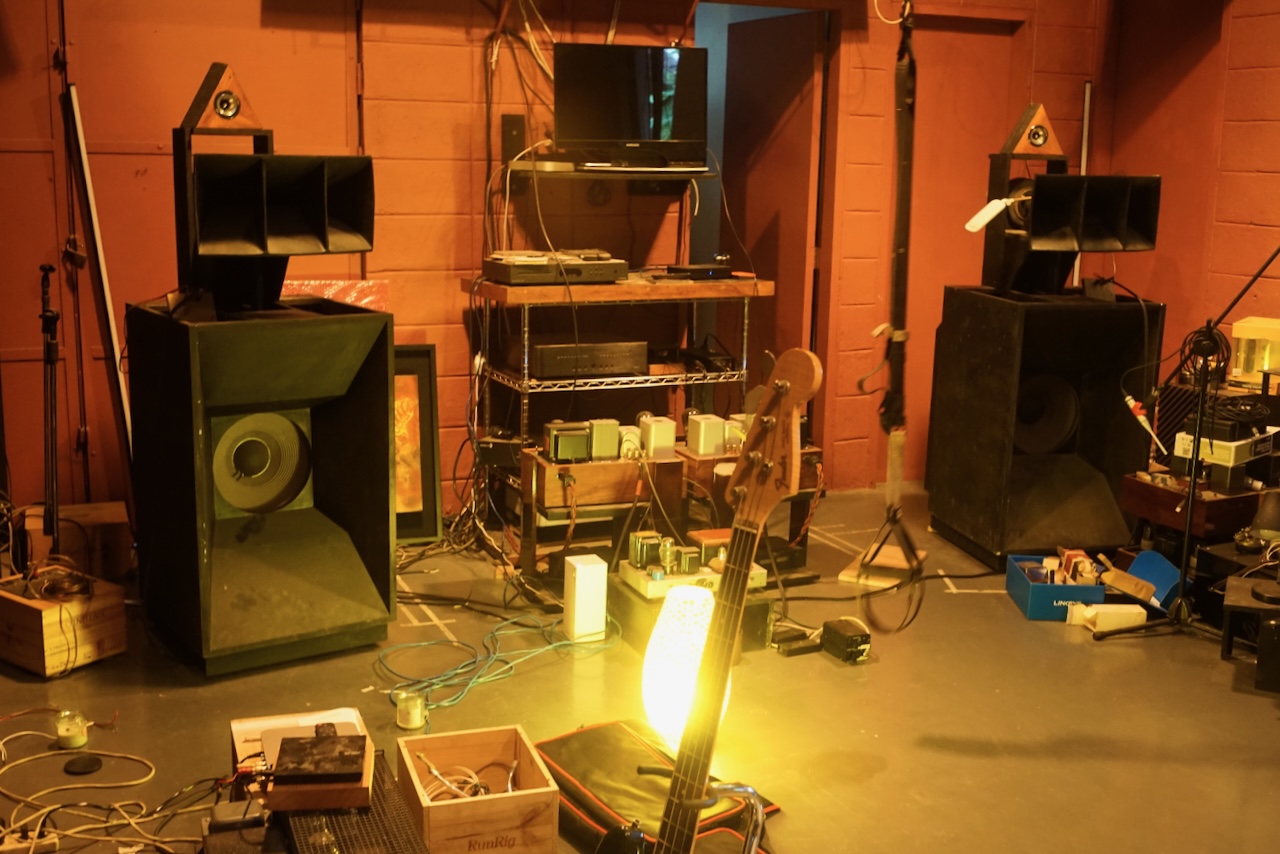
Altec 755C + Super Tweeters - Altec 3000H, Realistic 40-1375 and Peerless MT225

L > R: Peerless MT225, Altec 3000H and Realistic 40-1375

Although I prefer listening to my Altec 755As neat like a double shot of fine aged single malt, for certain well-recorded music, I hanker for richer harmonic overtones from the better spec'd Altec 755Cs.

Saturday, March 21, 2026

Western Electric 131A/133A Inspired Amp - Mono


While I was relishing a pair of Altec 32C horns in the attic during the late aughts, unbeknownst to me, my stateside audio comrades, Dave V. and Joe Roberts, were praising the same horn's virtues in audio forums. When these veteran audio hobbyists consider the Western Electric 124 one of the finest-sounding amps they've ever heard, I listen. 

See Dave's (@Salectric) WE124 amp project and WECo 133A clone thread started by another 32 horn adherent (@gilmorneau) at Hifi Haven.

Friday, August 22, 2025

Thrifted Hi-Fi

Last time, the Altec 753Cs were driven by my Resto-mod Magnavox 8601 amp. In the spirit of my Vintage Japanese Drivers page from my old website, the same amp will now be used in the context of audio components and speakers I found in flea markets, thrift stores and yard sales + some DIY added to the mix.

Sunday, June 15, 2025

A Tribute to Don Garber of Fi + Robin and Lipman!

Don Garber's Fi 2A3 amp Ad from Sound Practices

My first exposure to Don Garber's Fi 2A3 amp was at a gathering of burgeoning SE-DHT/High Efficiency speaker enthusiasts organized by Mike LaFevre of Magnequest and Peter Breuninger, then president of the Philadelphia Audio Society. This was held in the outskirts of Philly during the latter part of 1994. I attended to assist my friend Steve Melkisethian in exhibiting the Audio Note Kit 1 amplifier since he was the US distributor of Audio Note UK Kits, transformers and parts at that time. Sadly, these guys are no longer with us. 😔

Saturday, June 22, 2024

Lycan3R WP12024 Horn


A couple of months after I blogged about the 3D printed prototype of the WP12024 horn, Trieu sent a pair of these beautifully finished cast aluminum production versions. Included in the package was a set of parts for a horn stand patterned after the Western Electric original I've only seen in Stereo Sound Tube Kingdom.

Monday, April 22, 2024

SETUP 2024

Single Ended Triode Users of the Philippines 2024

At the dawn of the 21st century, I uploaded hifi systems owned by audio buddies who had been inspired by the Sound Practices ethos. These were the guys who originally coined SETUP. After a couple of decades, the number of Filipinos who indulge in this hobby has increased exponentially.

Here's what I saw and heard during my recent visit.😊

Harana Audio Workshop


Altec 311-60 horns + 288 drivers with Fostex super tweets on top of a pair of Harana V-Vent bass bins with partial horn loading

Sunday, December 17, 2023

3D printed WP12024 horn from Lycan R&R

In late September, I received a message from Trieu of Lycan R&R, asking if I'd be interested in evaluating his 3D-printed prototype pair of multi-cell horns.

Saturday, July 9, 2022

SRPP SE2A3 Circuit Redux

Back in the late 90s, I dismissed the hi-mu/low-gm SRPP input/driver because I found that the circuit had a tendency to sound tiring over extended listening. However, my memorable encounter with the Morikawa SE2A3 amp owned by my buddy Jose was haunting. I had to revisit this circuit just to make sure I left no stones unturned. 

Earlier this year, Steve of Angela Instruments shipped me the "shop mule" SRPP SE2A3 amp for a check up. After replacing the leaky coupling caps, the amp was as good as when I delivered it to the shop over two decades ago.  

My hotter operating point = slightly more power compared to Prof. Morikawa's SRPP 2A3 amp.

!!!WARNING!!! 

The voltages in this circuit are potentially lethal! Build at your own risk!

Click here if you'd like to try the SRPP 45 triode circuit.

Use a Hammond 302AX power transformer instead of T1 + T2 A&B


Click here to see the "cleaner" 10kHz square wave from the Morikawa SE2A3 amp

In spite of the 10 kHz square wave spike from the budget Hammond 125ESE output transformers, it was a very refreshing musical reunion with the Angela SRPP 2A3 amp. 

During its residency in the man cave, the amp powered my back up Altec 2-way system above, Altec 755As and Altec 755Cs in Silbatone cabs below. It was totally devoid of the listener fatigue I previously ascribed to the circuit. Even with the brightest and harshest software and/or hardware thrown into the listening chain, I couldn't induce the unpleasant quality which bothered me in the past. 

Then it dawned on me that I started doubting the SRPP's musical abilities when my Altec 2-way project commenced. Sorry SRPP, it wasn't your fault...😟


YMMV!😉


Saturday, June 5, 2021

morrison micro 2A3, reimagined + Kasuga Wireless KA6625ST output transformer

Joe Roberts' piece, "I Never Met a 2A3 Amp That I Didn't Like," from Sound Practices Issue 15, is very persuasive. I built jc morrison’s micro 2A3 amp soon after I received the issue via snail mail fresh from the printers in the mid '90s. After rereading the article in ‘07, I got inspired to make a Radiotron SE2A3 variant.

Friday, March 19, 2021

Snell Type JIII Part 1 - Deconstructed > Re-Foam

 In the late 80s, I could have gotten a Snell Type E or J after unloading my Magnepan SMGas. But I loved the sound of EMI and Decca recordings, for which I give credit to BBC-trained sound engineers, so I invested in a pair of Quad ESL57s and Rogers LS3/5As instead. I was such an Anglophile that I even became a partner in a company that imported Art Audio Amplifiers and Spendor Speakers to the Philippines. Unfortunately, we didn't make money...but that's another story.🤣

 
During a moment of nostalgia, I chanced upon this pair of Snell JIIIs online. I messaged the seller expressing interest. After two weeks of silence, I made a polite follow-up and was surprised to receive a reply that they were still available. According to the seller, he's had several offers from tire-kicking flippers but he chose to sell to me because I sounded like an enthusiast who'd give them a good home.😄


Typical of speakers from this era, the foam surrounds have disintegrated. Other than that, this is a very clean pair with consecutive serial numbers just like when they were sold in high-end audio salons in the late 80s to early 90s.


While waiting for the replacement foam surrounds, I thoroughly cleaned all vestiges of old foam from the cone and speaker frame. This was the most tedious and time consuming step in the re-foaming process but essential for a successful result!

 Meanwhile, I also took advantage of the down time to analyze what makes this speaker system tick. 

Deconstruction


Peter Snell was a very gifted speaker designer. Due to his untimely demise at age 38 in 1984, speaker models that were manufactured during his lifetime have developed a following. Peter Qvortrop of Audio Note UK was a big fan of the 2-way Type E, J and K models and continues their legacy in the Audio Note E, J and K using custom drivers and boutique parts.

The Snell E and J had front mounted reflex ports while the K was a sealed box/acoustic suspension design, which employed a different woofer. A rear firing 3/4" dome tweeter was added to the EII model, while the reflex port was moved to the back of the cabinet in both the EII and JII.

Vifa D26TG-05-006

The EIII, JIII and KII designation denotes the switch from a Tonegen 1" doped silk dome tweeter to the Vifa D26TG-05-006 6 ohm 1" dome pictured above. A tweeter level control was also added on all models. 

According to the Snell Type JIII brochure, the Vifa D26 tweeter handles an octave of upper midrange frequencies from 2.7kHz + another two octaves of harmonic overtones.


Even if the JIII was manufactured posthumously, it retains the cabinet dimensions and proportions of the original model. After many years of experimenting with open baffles, Altec 614 and 618 and  cabinets, I'm a firm believer in the acoustic superiority of Rubenesque front baffles over Victoria's Secret slim waifs.😆 


Was the use of plywood (top, bottom and sides) + chipboard (front baffle and back panel) chosen for acoustic reasons? Regardless, the cabinet is of pretty high quality construction with particular attention placed on rigidity - see the brace from the front baffle to the back panel in the picture below.


Good quality air core inductors, electrolytic and film capacitors or a combination of both + an L-pad for tweeter level adjustment were used in the crossover network.


The high-pass is a straightforward 12 dB/octave 2nd order slope hinged at 2.7kHz, as previously mentioned. On the other unit, there was an additional electrolytic cap in the high-pass section with a higher total capacitance reading. This confirms Snell's claim of matching their units to within +/- 0.2dB based on a reference model in their factory. 

Likewise, the low-pass section is also a 2nd order slope + an EQ/contour network for the Vifa woofer (see the LCR combo highlighted in red above). Explaining how this EQ works is beyond my technical ability. My empirical mind just knows that it "shapes" the woofer's frequency response. A similar, albeit more complex, crossover + EQ can be found in the BBC LS3/5A. 

Since all the capacitors measured close to their indicated values, there was no rationale to change or upgrade. Besides, I want to hear these speakers as close to how they were originally designed.


Vifa 8" M21WN-07-04

AFAIK, the Vifa 8" M21WN-07-04 was the only woofer used in the J, JII and JIII. Based on the 49Hz-20kHz +/- frequency response specified in the JIII brochure, and cross-referenced to my Musical Instrument Frequency Chart, this drive unit/cabinet combo was tasked to cover six and a half octaves of musical information starting from the bass frequencies up to midrange fundamentals. 


Re-Foam


After judiciously sifting through audio sites on the net, I chose the $25/pr. foam surrounds from Simply Speakers because they were recommended by audio hobbyists who exhibited good ears and common sense. Check their re-foaming video for a straightforward and confidence-inspiring tutorial.


 The Vifa M21 voice coil is essentially self-centering. So don't even consider cutting or removing the dust-cap to shim the voice coil. It'll be ruined because the cone + dust cap is one whole piece. 


Not bad for a first attempt in replacing foam surrounds, huh? 😉


Since time immemorial, I've been evaluating drivers bare naked (or mounted in a simple baffle) to hear their potential. After 25 years of enjoying Altecs, these drivers sound very different...🤔  


Snell JIII in room RTA (Onyx iPhone app) 
Snell JIII specs

I have to live with this speaker system for a while and play lots of tunes 🎻♫🎶♬🎺and will report back in Part 2!😊


See Part 2 and Part 3

Thursday, July 2, 2020

Reality Check: Musical Instrument Frequency Chart + A Tidbit of Wisdom from Radiotron 3rd Edition


Musical Instrument Frequency Chart


This musical instrument frequency chart should serve as a reality check for those who obsess about metrics. During the triode era and up until cycles per second (cps) was replaced by kilohertz (kHz), a bandwidth specification of + or - 1dB from 30-15,000 cps was considered state of the art. That old standard actually made more sense if we look at the bandwidth of acoustic instruments in the chart above.

The chart is also a practical reference for all of my speaker/driver/horn articles past, present and future. Likewise, it is a handy visual aid to interpolate the pink noise + iPhone Real Time Analyzer (RTA) app traces even if in most cases they don't correlate to what we hear.😆  

In a couple of instances, an RTA trace has agreed with what I heard. In reality though, pink noise and other waveforms used for audio testing have nothing in common with musical notes and harmonies. Audio measurement is very far removed from the dynamic nature of music. To me, the RTA, audio generator and oscilloscope are tools that can be helpful if used with discretion.

Altec 755A in an Open Baffle


My adventure into high-efficiency speakers started with a pair of Altec 755Cs (and later, 755As) mounted on this very same open baffle. It was easy for me to appreciate the lack of boxy coloration, having lived with Quad ESLs for a couple of years.


Most open baffle detractors complain about the lack of bass response. However, the above trace doesn't pale too much in comparison to the Altec 755A + Dr. Bae/Silbatone box and Altec 755A + 618 below, even if it does look ugly!🤣

Maybe the suck out between 250-1kHz is what I hear as the absence of cabinet coloration or the "lack of snap" J-Rob heard?

Dr. Bae/Silbatone Box + Altec 755A


Despite being very compact, this empirically designed box exploits the fullest potential of the 755A driver. 


This trace looks better than the 755A + OB above but not as nice as the Altec 755A + 618 trace below.

Altec 755A + Altec 618

[2 cubic foot sealed box]


A pair of Altec 618 cabinets

The Altec 618 is the classic 2 cubic foot sealed box for the 755. It has to be rigidly braced to minimize upper bass/lower midrange coloration, although some listeners may prefer that "warm" bloom.

Altec 755A in the 618 box

This trace is the flattest of all three. But subjectively, the Dr. Bae/Silbatone box + 755A sounds more neutral and tonally more accurate. I don't hear the sudden rise from 1 kHz and peaks at 1.5 and 2 kHz. 

The Altec 618 box is now loaded with 755Cs and has great synergy with the JLH 1969 clone amp.

Altec 753C


 My exposure to the Western Electric WE757A and WE753C in the late 90s inspired the Altec 2-way project. The sound of those two classic speaker systems was already familiar. They sounded very similar to the 755A with more extension in the low end + airier highs. But what really sent me on a quest to emulate them were: greater efficiency so that I can enjoy my flea powered SE-DHT amps and less congestion (more layering and instrument separation) at higher SPLs. The Altec 753C is the final destination of that journey. 

Along the way, the Altec 755A was my loyal guide for midrange accuracy and coherence, which is why I discussed the driver in its various guises above.

Altec 414A in the ported 753C cabinet

The Altec 414A woofer running in full-range mode covers at least six octaves, from 45 Hz until it starts rolling off in the 3 kHz region. Unlike most drivers of this size and type, this is very smooth-sounding and delivers a great midrange without nasty cone break up modes up to its natural roll off point.

Prior to using the 414A, I had a pair of Altec 419A Bi-flex. I also seriously considered a pair of Altec 416A but both drivers exhibited nasty peaks starting from 1-3 kHz. Now I wonder if those peaks would've been visible using pink noise + my iPhone RTA app? 

I could've studied how to filter the peaks using EQ. However, all these extra crossover circuit complications would've adversely affected the efficiency of the speaker system, which I wanted to avoid. In the end, I stuck with my original plan of keeping it simple.

Altec 414A


Fundamental frequencies below 45 Hz may look rolled off in the trace but the harmonic overtone series (hence, harmonics or harmonic overtones) of the frequencies below the roll off point reinforce the [weak] fundamental in making those lower frequencies audible in actual musical reproduction. The BBC LS3/5A is a good example of a small speaker that "reproduces" low frequencies via harmonic overtones. 

My straightforward explanation: A:27.5 Hz played on an upright piano will produce less intensity as a fundamental note compared to that from a nine-foot concert grand because the instrument is physically smaller and the length of string, shorter. However, that upright piano's A:27.5 Hz is still perceived as A:27.5 Hz by the human ear, albeit less visceral, because of the harmonic overtones produced. 

Due to the 414A's sharp roll off past 3 kHz, the upper frequencies need reinforcement. 

Altec 32C horn + 802D + 20275 diaphragm
XO below

For many years, I struggled to make the Altec 811 horn work in this context. I started crossing it at around 900Hz @ 6dB/octave slope. Then, I cloned the Altec N1600C crossover, which effectively raised the crossover point an octave higher with a sharper 12dB/octave slope. 

None of these crossovers could blend the 414A and the 811/802D coherently to mimic my favorite full-range driver, the 755A. The "shouty distortion" was always present even with a simple 2 uf paper in oil cap + variable L-pad.

Altec 32C + 802D

After several years of frustration to the point I almost gave up, a fortuitous meeting with the Altec 32C horn opened a whole new world for the better.😄 It turned out that the objectionable "shout" I was hearing emanated from the Altec 811 horn.

The Altec 32C horn + 802D driver combo fill in the last 2 octaves of fundamentals + another 2 octaves of harmonic overtones using the high-pass crossover below. 

Sound Practices


I've learned so much from getting to know the Altec 755A, 755C, 414A, 802D and 32C intimately as well as from the other components that I ultimately rejected. 

The countless hours I spent assessing and listening to these transducers individually is a sound practice I highly recommend to audio DIYers!

Simple Crossover


Ever since I discovered the sonic delights of paper in oil as coupling capacitors in the signal path of preamp and amp circuits, I've also adapted their use in crossovers. 

Altec 753C crossover using paper in oil capacitors + Mills
non-inductive resistors
schematic

I've found the RTA to be helpful in adjusting crossover points with the help of a crossover calculator. A simple example: if the sound is harsh, move the crossover point higher. If you need more bite or presence, go lower.


Altec 414A + 32C horn + 802D compression driver  +
JP 753C ported cabinet = Altec 753C

If I were to summarize, the Altec 753C sounds lush and romantic!


Driven by 3500 milliwatts per channel of SE-DHT power, these speakers allow me to enjoy Mahler symphonies in my man cave with nuanced macro and micro dynamic contrasts. It gives a middle of the hall presentation which is my preferred perspective. The midrange is warm and coherent with a nice three dimensional quality.

Even if the extreme lows are curtailed, the harmonic overtones produced in this frequency region have enough foundation for big orchestral works. There's a wispy ribbon-like airiness in the extreme top which, to my ears, no longer need help from my pair of Altec 3000H super tweeters.

I probably could've gotten another half octave of bass extension if I chose the 15" Altec 416A woofer, but then I would've run into problems blending it with the 32C/802D horn/driver using a simple crossover. Even if I succeeded in EQ'ing out the peaks of the 416A, efficiency and midrange coherence would've suffered.

Everything is a compromise and I believe I've chosen wisely.

Wanted: smooth sounding 12"-15" wide range driver + horn + compression driver


Although Great Plains Audio is still manufacturing the 414 and 802 drivers with alnico magnets, IMHO, the listed prices are too steep to even attract the attention of the DIY community or smaller boutique manufacturers. 

I've used and highly recommend their replacement aluminum diaphragms for 1" format compression drivers. I've been told that the GPA 414 doesn't sound like the classic 414A/Z/8B/16B and is 3dB less efficient. However, I don't have hands-on experience with the GPA drivers to confirm any of those claims.

GPA is our only direct connection to the past when transducers were designed using human ears aided by measurement tools. For that alone, I want them to succeed!

Radiotron, 3rd Edition Redux


Let's (re)visit a topic that has served the interest of the entire audio industry, except the bottom-line of this hobby - the enjoyment of music!


Sad to say, no one has heeded D. Massa's advice. 

Besides, the test tones used for distortion analysis have no bearing whatsoever to the highly dynamic and complex harmonies contained in the simplest musical score.


Yup, this was 80 some years ago and there still are self-proclaimed audio pontiffs who insist on this metric!🙄