Showing posts with label 414. Show all posts

Friday, November 15, 2024

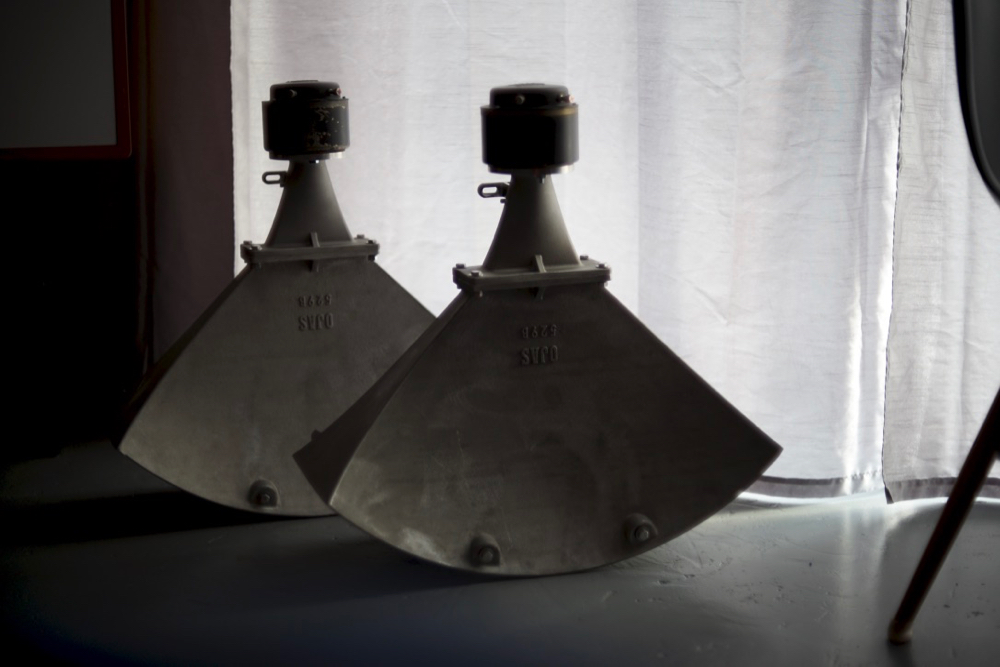
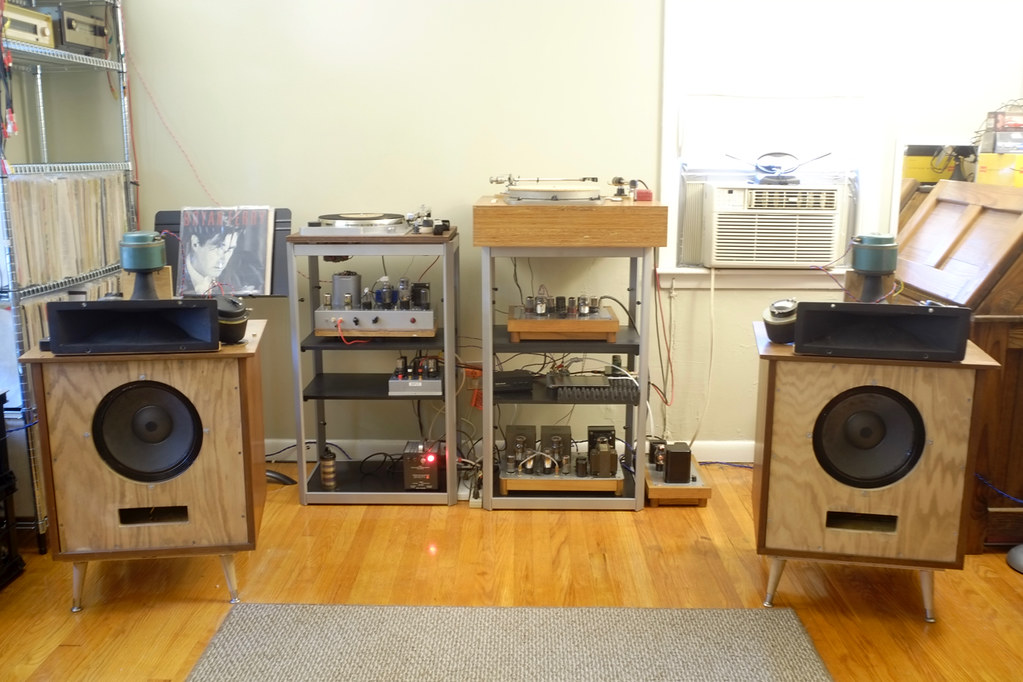
Intact Audio Speaker Autoformer + Lycan3R WP12024 Horn


I ordered the Intact Audio speaker autoformer with a -6dB to -15.5 dB/0.5dB attenuation range based on the fact that my Altec 802 drivers are about 12dB more sensitive than my 99 dB/1W/1M Altec 414A woofers. Other than that, I went into this project hoping that Google would be my friend, only to find out it wasn't!😉

Since I use external crossovers for my Altec 753C, disconnecting (and reconnecting for comparison purposes) the Altec 32C/802 horn/compression driver is a breeze. The 753C-style cabinets essentially serve as bass bins in which the 414A woofers operating in wide range mode (unfiltered) + the 20275 diaphragmed 802 compression drivers mounted on the Lycan3R WP12024 horns are perched on top!

Saturday, June 22, 2024

Lycan3R WP12024 Horn


A couple of months after I blogged about the 3D printed prototype of the WP12024 horn, Trieu sent a pair of these beautifully finished cast aluminum production versions. Included in the package was a set of parts for a horn stand patterned after the Western Electric original I've only seen in Stereo Sound Tube Kingdom.

Friday, March 8, 2024

OJAS 529B Horn


During my visit to the OJAS listening room late last year, Devon asked me to evaluate a pair of horns OJAS developed in collaboration with Lycan R&R. The OJAS 529B is a 500 Hz horn rescaled from the large format Altec 329A for use with 1" format Altec/GPA compression drivers.


  This horn was designed with a throat inspired by the Western Electric 32 horn to avoid the harshness and distortion I (as well as others 😉) associate with the Altec 811 and 511 horns
For more details about this horn's evolution and construction, please click here.

Thursday, January 20, 2022

A Cousin's Listening Room


This is a hifi system I built for a cousin who loves music!

The speakers, which I dubbed Altec 753C, is the culmination of my Altec 2-way horn system project.

Western Electric 753 inspired cabinets meticulously handcrafted by John Piro of Hommage Audio

Garrard 301 turntable + Ortofon RMG309i tonearm + Ortofon SPU Synergy for stereo LPs and Alfred Bokrand AB309 + SPU Mono for mono LPs 

Turntable plinth by Hommage Audio

The JE Labs preamp line stage is a plate choke loaded 76 while the SE300B mono block amps feature a Komuro-inspired circuit using type 37 input tubes + Intact Audio nickel plate choke loaded 6V6s or 6F6Gs (connected in triode) and Hashimoto H-30-3.5S output transformers. 

Preamp and amp woodwork by Hommage Audio.

Hifi cabinet by George Nakashima Woodworkers.


Projects like this keep me busy during the pandemic.😊


Saturday, August 15, 2020

JP's Western Electric WE757A Remake


Those were the words of the late Walt Bender in Part II of his Olden Golden Components article in Issue 51 of The Absolute Sound (TAS) in the Winter of 1988. This was my first exposure to Western Electric audio equipment. I eagerly awaited TAS's promised feature of Walt's Western Electric-based audio system but that never materialized. I let my TAS subscription lapse and replaced it with Glass AudioSound Practices and Vacuum Tube Valley

My only encounter with an original WE757A was a single unit being tested on the tailgate of a Honda Civic hatchback at a ham fest in the early 90s. Keep in mind that this speaker system predates the stereo era by at least 10 years, thus, they were never available in stereo pairs.


In this day and age, the only way a mere mortal can experience a Western Electric WE757A speaker system is to build one using as many of the original parts as one can gather.


This is exactly what John Piro did. He combined a WE/Altec 728B driver with a slightly dented dust cap + the botched up KS12027 he expertly repaired to properly mount an Altec 802D compression driver. 

Then he painstakingly cloned and crafted a WE757A cabinet to house these components. Soon after the speaker system was completed, we met at the Kutztown Fall 2019 Radio Show and he entrusted the evaluation of this speaker system to me.


In keeping with JE Labs methods, I started by evaluating the drivers individually and then compared the JP WE757A to my Altec 753CI was fortunate to have had lots of time to dissect and enjoy the JP WE757A. Thanks, JP!

WE/Altec 728B


When I visited J-Rob in the summer of 2018, I spent quality time listening to his pair of WE728Bs while talking shop. The very rich harmonic overtones they produce captured my attention just like a fine violin does.

The smaller Altec decal is pasted over the larger Western Electric original. 
JP surmises that this unit started life as a WE728B which got damaged early on 
and was re-coned by Altec using an original WE re-cone kit. 

Technically speaking, the WE/Altec 728B is neither a woofer nor a full-range. It's a wide-range speaker. The RTA trace shows a seven octave range, which pretty much mirrors the original 60-10,000 kHz specification. 

WE/Altec 728B

The 728B tonal balance is very much like its smaller brother, the 755A, with an additional octave of extension in the bass and about an octave less extension in the highs. This and the Altec 414A are the only 12"-15" drivers that I've heard (so far) which don't break up in the 1-2kHz range resulting in shouty female vocals, amongst other nasties.

Dented dustcap

From the upper bass to upper midrange, the 728B has the J-Rob  coined "snap," which it shares with its 755A and 756B siblings. IMHO, these permanent magnet drivers are unparalleled to this day for their life-like midrange and ability to convey a three dimensional realism. OK, perhaps the Western Electric and GIP field coil drivers are even better but as I said earlier, this article is for mere mortals.😉

WE754A vs. WE728B


In the midst of my evaluations, I exchanged private messages with another Western Electric aficionado who's had the rare 
opportunity to compare the WE754A and WE728B drivers. He is currently assembling a pair of WE757As.


 With his permission, I'm sharing his valuable listening notes. Thanks, Jonas!

Just wanted to let you know what’s going on with my 757 style speakers. I was blessed to find a WE 728B in an old console in pristine condition. I was able to compare the 754A and the 728B and I liked the 728B much more. The 754A has perhaps a bit more lows but a thicker lower midrange, and less detail and dynamics, and not as smooth as 728B. Compared to other speakers they were very smooth, but when I heard the 728B with a complete absence of grain or distortion, the difference was apparent. They sounded great on things like Gerry Mulligans Baritone Sax on Night Lights. The 754A’s are made for that sort of thing and I think those who love thick midrange would really enjoy them. But they also didn’t have quite as much highs, at least to my ears. I ran them full range so it would have been nice to try out different crossovers to see if the 754A would have been better with a lower cut off. Perhaps so. 

Anyway, I sold both 754A speakers to a young gentleman from NYC who's uncle is a big WE collector from Korea and it was very cool to meet such an WE enthusiast. The uncle came by to listen to them. He apparently has original 757 speakers among many others and said he uses PX-25 tube LS in his amp. With that money I found a second 728B in similar shape to my other, and they are now installed in the John Piro cabinets. 

I do wonder about the differences of the 754A and 728B in the intended applications. The 754A came before the 728B. There is some a lot of talk about it (a bit of ad copy hyperbole but very interesting still) in this issue of Oscillator Magazine, which was put out by Western Electric. Amazing that they put that much time and effort into a trade publication, and to think of what went into the design of these. 

It seems they created the 728B as an updated or “improved” version of their 754A. What I’ve heard is that the 754A has a copper wound voice coil while the 728B had aluminum. Also there’s the obvious difference in magnet structure and power handling.

They sure sound very different. The imaging and spatial depth is far better in the 728B, at least in these cabinets. The 754A seemed to beam more. Of course the published specs aren’t much different nor are the dispersion characteristics listed in the WE specs, but the 754A seemed to beam more in my cabinets. It’s almost like the 728B strip out any unnecessary frequencies and things have a nice space and clarity while the thick midrange of the 754A brought certain instruments out front at the expense of this clarity and separation of instruments. At least to my ears.

So, part of me wonders if they had just made the theater speakers earlier, designed using the 754A, if they were just trying to use up stock, or if there was a specific reason to use them instead? The 754A is slightly more efficient by 1db, and it seems to play a bit lower and have more low range frequency happening even if they go to the same rated frequency range according to their literature. (it was hard to be sure if the 754A went lower, but the lows were more filled out).

Perhaps this increase in lows, even at the expense of clarity and spacial clarity between instruments, was the reason they were used in the theater amps.

Regardless. It seems that WE put considerable thought into the new 728B. I prefer the 728B a lot myself. I wish you could compare them and do a write up! I really look forward to your future blog posts. 

Best,

Jonas Baker


WE/Altec 728B vs. Altec 414A


Altec 414A

The 414A has finally met its superior adversary. In direct comparison with the 728B, the sharp roll off around 4kHz makes the 414A sound less snappy and comparatively muffled.

Altec 414A

The main asset of the 414A over the 728B is a little more than half an octave of extension in the bass range and a couple of dB more in efficiency. In spite of the 728B's obvious superiority, my admiration for the 414A remains, much like my fondness for the 755C.😉

KS12027 vs. Altec 32C


KS12027 horn

KS12027 + Altec 802D + 20275 diaphragm

Since my capsule review last year, I learned more about the nature of the KS12027 horn. The KS12027 surpasses the 32C and Azzolina KS12024 in presenting distinctive harmonic overtones from lower frequency instruments like cellos, basses and, believe it or not, even from the tympani. Vocals and acoustic instruments are uncannily real and three dimensional, just as they are with the 728B, albeit scaled to small format horn proportions. 

When I compared the Altec 32C to the KS12024,  I noted a distinctive "in your room" presence with the latter. This quality is even more prominent in the KS12027, which is another multi-cell type horn.
 
Altec 32C
Altec 32C horn

Altec 32C + 802D + 20275 diaphragm

Comparatively, the Altec 32C sounds more laid back than the KS12027. Vocals and lower frequency instruments like cellos and basses had less of the life-like harmonic overtones rendered by the KS12027. High frequency transient speed is also slightly slower. Thus, brushed cymbals and high hat tend to have a splashy quality instead of lightning fast attack and decay coming out of the KS12027.

Although the 32C has the wispy airiness at the extreme top end which the KS12027 wasn't able to match, the addition of the Altec 3000H was not as successful as my previous experiment with the Azzolina KS12024. I think the 3000H can't quite match the transient speed of the KS12027.

I've said it before and would like to emphasize further that the KS12027 is the most natural and real sounding small format horn I've listened to. 

Simple Crossover


Since I don't have access to the original WE702A crossover schematic of the WE757A, I made a simple high-pass 1st order crossover hinged at 5kHz and ran the 728B unobstructed. Definitely not optimized, but good enough for me to enjoy the speaker system.

Altec 753C vs. JP's WE757A


All my listening was conducted using the je2a3 mono integrated amp with Hashimoto H203S output transformer, fed by the following sources: Gates CB77/Gray 108B/GE RPX and Neat P58H/Calrad SV16/DL102, Magnavox CDB650 transport > Arcam Delta Black Box DAC.


Altec 753C

The Altec 753C is very lush and romantic. It gives a middle of the hall presentation compared to JP's WE757A. Its only advantages over JP's WE757A are: almost an octave more bass extension (albeit with less definition), a couple dB more of efficiency and the wispy airiness in the very extreme top end noted earlier in the 32C/802D pairing.


JP/WE757A

Typically, components with similar qualities don't complement each other because their virtues cancel out. However, in this particular case, the WE/Altec 728B + KS12027/802D was an utterly cohesive and coherent blend.

JP's WE757A sounded neutral and more analytic in a very musical way. Transients come across crystal clear and clean. Dynamic nuances at macro and micro levels are also much better conveyed. Even if the music is presented closer to the stage with greater detail and resolution, I didn't experience long term fatigue. 


In spite of the slightly less bass extension vs. the Altec 753C, definition was better. Due to a tad less efficiency, it can benefit from slightly more power. Perhaps an SE300B amp would've improved bass extension and dynamics further.

The sense of realism from its three dimensional midrange is a result of the life-like harmonic overtones produced by the 728B + KS12027/802D pairing.


The Altec 753C set a very high musical standard but JP's WE757A cabinet remake + Altec 728B + KS12027 horn + Altec 802D is more organic, finer and nobler in stature. It brought me closer to the music! 

Now I'm asking myself, how much better would it be with the original WE713C compression driver and the optimized WE702A crossover?


The WE755A, WE756A, WE754A, WE728B, WE753C, WE757A, etc. came from an era when America was at the height of its industrial might. The amount of R&D that went into these transducers will never be equalled. Sadly, these are more appreciated in Asia and Europe.

To add insult to injury, many American audio hobbyists even sneer at these foreigners who pay top dollar for these American-made classics. This gives credence to the saying, "no one is a prophet in their own land."


Tuesday, July 16, 2019

KS12027 Horn


The KS12027 horn perched on top of my repurposed Altec 861 cabinet loaded with an Altec 414A woofer should actually be residing inside a ~ 4 cubic foot slanted cabinet with a Western Electric WE713C compression driver  bolted to its throat + a WE728B 12" woofer = Western Electric WE757A monitor speaker system.

I was honored to host this KS12027 horn and provide more modest accommodations for a couple of weeks courtesy of my audio preservationist buddy John Piro.


He rescued this KS12027 horn with a damaged 0.7" aperture and repaired/modified it so that mere mortals like myself can sample its delights using a more pedestrian 1" exit Altec 802 compression driver. 

Mono Hi-Fi set up: Neat P58H + Calrad SV16 + GE RPX or DL102, JEL SE2A3 mono integrated amp with Hashimoto H-203S OPT.

All of my listening was done with the above set up.

Altec 414A + mod'ed KS12027 + 802 + GPA34852

From the moment I mounted the KS12027 + Altec 802 combo above the Altec 414A woofer, the first adjective that came to my mind and stuck for the rest of its stay was, natural! Just like its WE/Altec 32 and KS12024 relatives, this is also a horn that doesn't sound like a stereotypical horn. In fact, the articulation (attack and decay of notes) and overall presentation of harmonic overtones via the KS12027 is even more natural and realistic. It made the Altec 32A/32C and Azzolina KS12024 sound merely like very high quality Hi-Fi which mainstream audiophiles may find more appealing. These findings were echoed by my friend Ding during his recent visit to the man cave.

Altec 32C, KS12027, Azzolina KS12024

Even if I loved the KS12027 so much, I didn't want to get attached to something I may never be able to own. So this past weekend I met up with John at a ham fest and handed back this valuable piece of audio history. After giving him my rave report, which is hardly representative of what most audiophiles like nowadays, he was not dissuaded. He is still seriously considering reproducing them. 😎


Monday, April 1, 2019

Altec 753C

After many years of raving about the Altec 32 horn, the only stone left unturned was using it as it was originally designed, that is, with the compression driver oriented to radiate upwards.

Last year, I received a message from John Piro, whose beautifully crafted preamp project was previously featured in this blog. He sent me pictures of his interpretation of the legendary WE753C using an Altec 414-16B woofer + Altec 32A + Faital Pro driver

Altec 414A + 32C + 802D + 20275 

I was very impressed and requested if he could build a pair for me. We finally met at the Kutztown Radio Show last September. He and his wife had dinner here at home when he delivered my beautiful cabinets!

A Western Electric 753C used as a monitor at WABF in the early 50s

As an homage to the legendary Western Electric 753C, which was a major inspiration for this project, I henceforth christen this speaker system as the Altec 753C.

Altec 2-way XO redux

I've settled on running the 414A woofers in full range mode (ala J-Rob) and replaced all the crossover resistors with non-inductive 12W Mills. This took away the last vestiges of grain in the upper frequencies.


RTA Graphs

Altec 2-way

Altec 614 + 414A + 32C + 802 with GPA34258

The above RTA was taken from this blog entry

VS

Altec 753

Altec 753 + 414A + 32C + 802D with 20275

I could've lived happily with my Altec 614 or repurposed 861 (aka Madrid) cabs + the inverted 32 horn situated on top. However, with proper horn orientation, the sound was taken to another level of refinement. Now the blend between the 414A and horn is practically seamless and I bask in the airiness of the top end, which I attribute to significantly improved high frequency dispersion, precisely as envisioned by Western Electric engineers.

In spite of the stellar midrange performance of the Open Baffle mounted Altec 755As, I started the Altec 2-way project in the late 90s to address the following issues:

1. More efficiency
2. Extend the frequency extremes
3. Less congestion in dynamic peaks with complex musical passages

After 20-some odd years, those goals have been realized. The Altec 753C is pretty much end game!


Thanks to my buddy Joe Roberts, who explained the intricacies of proper 32 horn orientation. The idea was carefully stored in my mind. I just had to wait for the right opportunity to implement it. And of course, a big thanks to my friend John Piro (aka RCA NUT), craftsman extraordinaire!

Let's hear some music. 😊


Friday, May 4, 2018

JE Labs Hi-Fi Man Cave 2018

  From Attic Hi-Fi to Hi-Fi Man Cave


Components


Cartridges: Ortofon SPU GME Classic, SPU #1s, Denon DL103R, DL103CI, DL103S, DL103, GAS "Sleeping Beauty"and Fidelity Research MC44
MC Step Up: Tamura TKS83 and Peerless/Altec 4722 transformers

Digital Sources: Sony DVP NS755V, Raspberry Pi 3b+/Moode Audio 4.1 and iPad mini
Line Transformer: Western Electric WE111C, UTC A20, Altec 15356


Cables:  DIY Mogami/Neglex 2534 for phono, Kimber KCAG and DIY PBJ, Telco Flex III 14 AWG speaker cable retired the Kimber 4TC

Right Side

LPs and other components 

Left Side

Books, magazines and cameras 

It's not always neat... 
pulled out the Altec 755A and OB 

when my bud Ben C visited 🍻

Living Room 


Speakers: repurposed Heath AS10 + Altec 802 driver + Altec 32A horn 


Turntable: Neat P58H + Calrad SV16 (or Velvet Touch) + DL102 or GE RPX
Amp: JEL mono integrated SE2A3 + Western Electric WE111a repeat coil stereo to mono mixer
Tuner: Sherwood S-3000 II
Digital Source: Lenovo laptop
DAC: XtremPro X1 USB DAC