I've become cynical of the latest is best mentality because in my 30 years of searching for sound that pleases my ears, I've always gone back to move forward. From this experience, I've learned to use planned obsolescence to my advantage by investing in old school components that have achieved classic status.
There is a common denominator between the Philips TDA1541 DAC chip and the Western Electric 300B directly heated output triode vacuum tube. The former brought digital sound to everyone’s homes in the '80s, while the latter amplified talking pictures in movie theaters in the '30s. Both have also been rediscovered for their distinguished musical abilities.
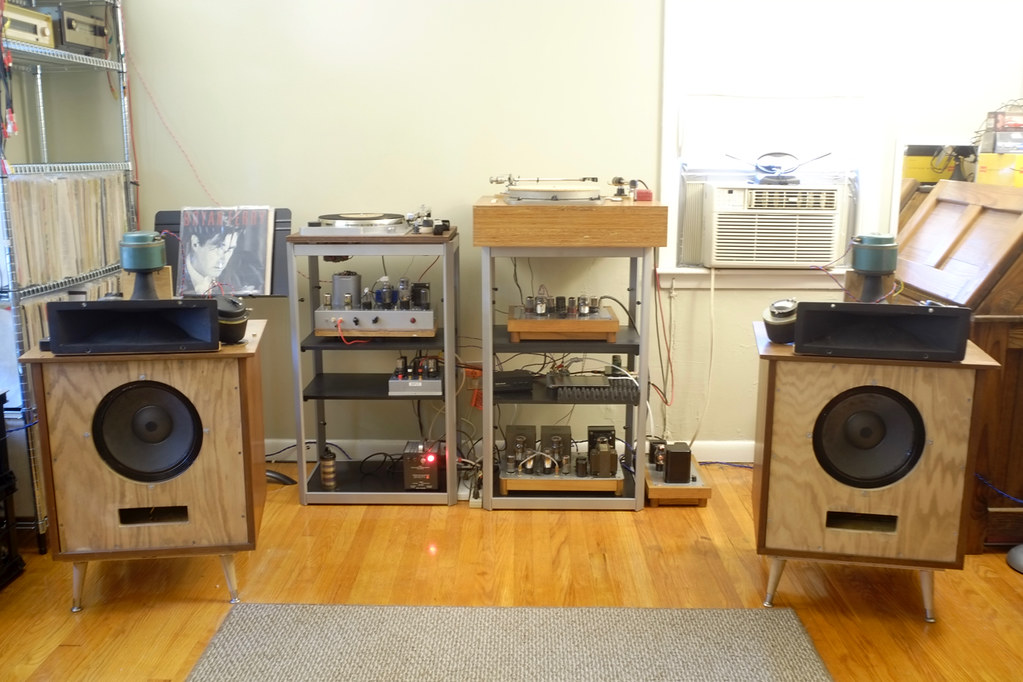
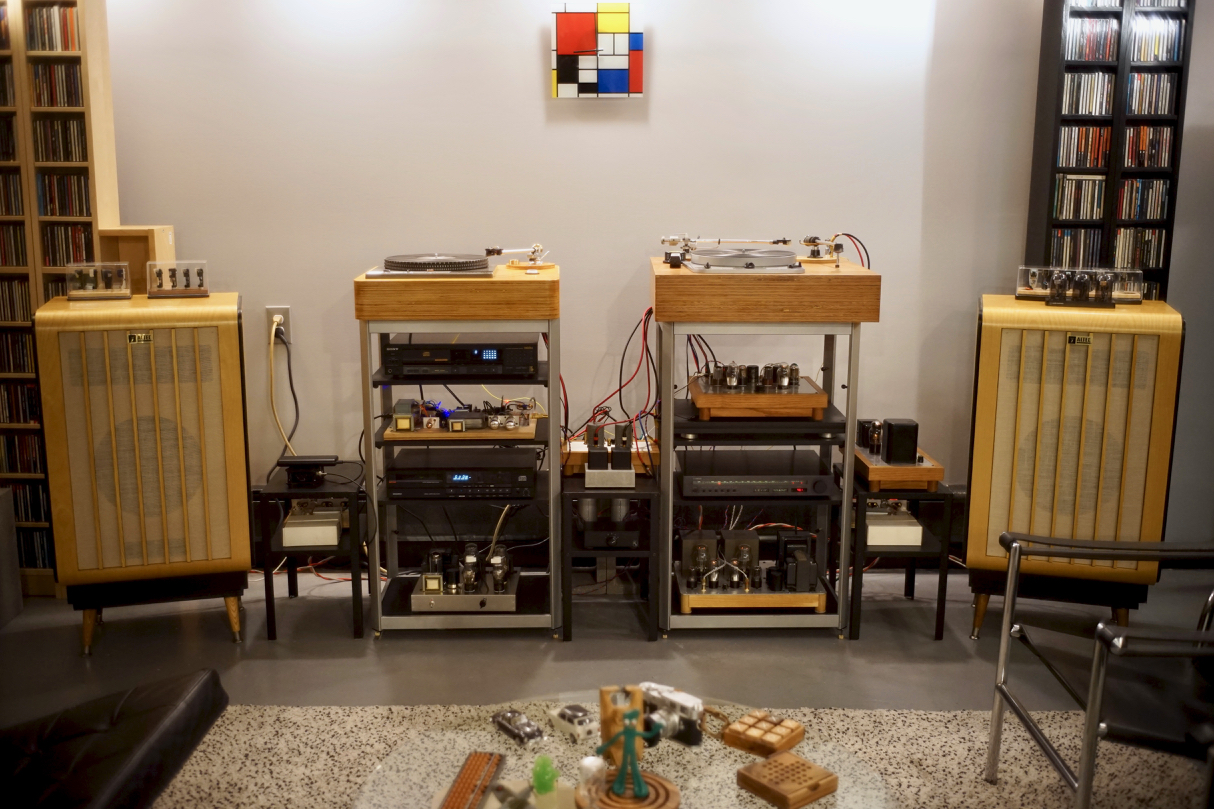
Left = JE Labs clone (by John Piro) Right = J-Rob's Silbatone original
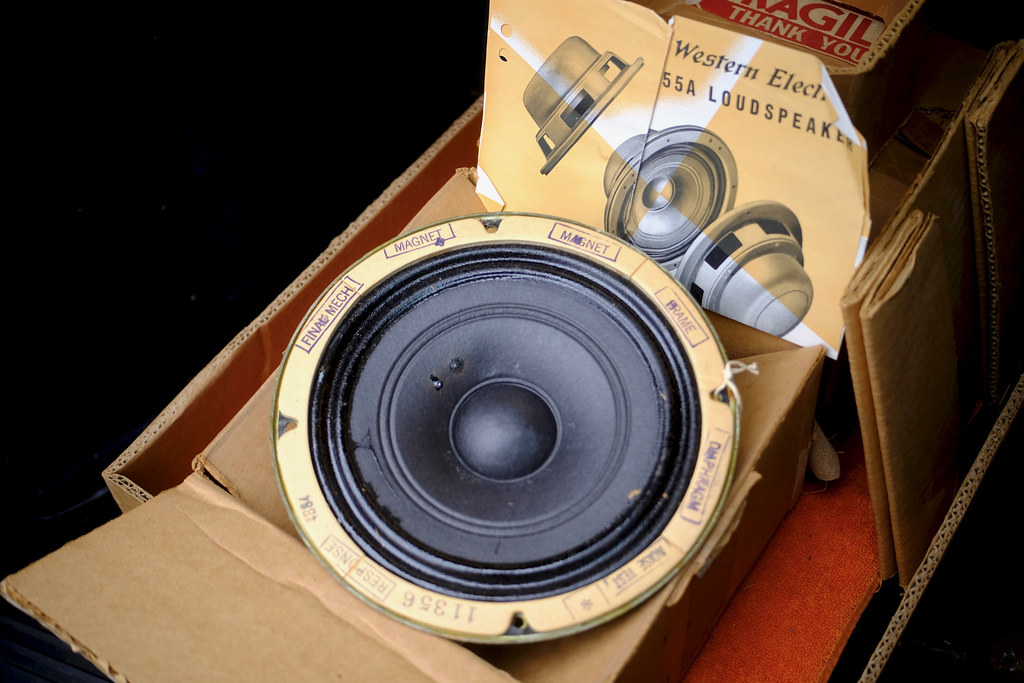
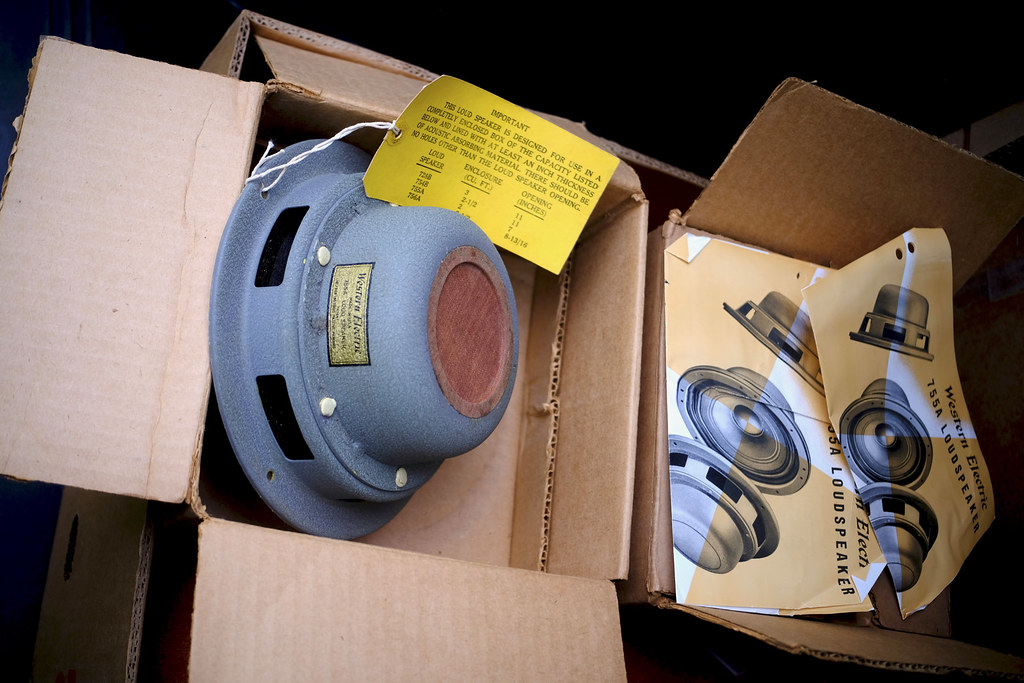
"The cabinets were designed by genius Silbatone engineer Dr. Stefano Bae as a group project for the Silbatone-sponsored DIY/Western Electric forum in South Korea. 100 pairs were quickly sold out, immediately driving up the world price for 755As. The original uses Silbatone's custom silver litz wire, which is said to be an essential ingredient of the original recipe, and top shelf WBT connectors.
Over the years Silbatone designed and made literally dozens of experimental boxes, including back horns for up to four (755A) drivers per side. This was probably the most successful, although rather modest.
My analysis of this untuned little cabinet is that it falls under the 'small box with a hole in it' design paradigm."
Having been a happy user of a John Linsley-Hood (JLH) 1969 Class A amp cloned by Nobsound, I was intrigued by the JLH Class A headphone amp boards featuring discrete circuitry (no ICs or op-amps) advertised on eBay. In the midst of the 2020 lockdown, I ordered this $25 pre-assembled board, which arrived in a padded pouch within 10 days. I also got a surplus 24 VCT @ 2A power transformer for another $15.
!!!WARNING!!! The voltages in this project are potentially lethal! Proceed at your own risk!
Typical of Chinese kits, this board didn't come with instructions or any type of documentation. But the board is marked for an experienced DIYer to decipher and set up in no time. Unlike the original JLH 1969 design, which needed DC blocking capacitors at the output due to the single rail supply, this headphone amp module was updated to work with a dual rail (+/-) supply so the output capacitors can be omitted.
Unfortunately, I couldn't get stable zero DC offset at the output terminals. Trimming for zero volts after 30-45 minutes of warm up was not a guarantee that in another 30 minutes it'll still be zero - I've measured as much as 0.3V.😞
Since I didn't want to risk frying my headphones and classic speakers, I installed 2500uf @ 16V electrolytic blocking capacitors at each channel’s output. Then, I bypassed the electrolytic caps with hermetically sealed 4uf paper caps just like I did to the Nobsound NS02g.
Top trace = audio generator Bottom trace = amp output
In spite of the DC blocking caps at the output, the square waves still show excellent bandwidth, transient response with no trace of ringing.
Before clipping, I measured 250mW/channel @ 4 ohms, 500mW/channel @ 8 ohms and 950mW/channel @ 16 ohms, 1.2W/channel @ 32 ohms, 395mW/channel @ 150 ohms, 190mW/channel @ 330 ohms and 115mW/channel @ 560ohms. I pretty much exhausted the resistor values from my parts bin to emulate the nominal impedance of typical headphones.
The 115mW output into a 560 ohm load shouldn't worry headphone enthusiasts since this amp drove my Austrian AKG K240/600 ohm Monitor cleanly beyond SPLs my ears could tolerate. It also had no issues driving less efficient ortho-dynamic headphones like the Fostex T50RP MKII below, courtesy of my friend Nate. Thanks, buddy!
This amp definitely outclassed the Rat Shack mini amps I'm fond of. Its class A design's purity and transparency puts it on another league. Unfortunately, Class A amp designs require a more substantial power supply, which is incompatible with portability.
The character of this amp is exactly like that of its bigger brother, a fatigue-free solid state amp that almost (but not quite) succeeds in sounding like a good tube amp!
Although the Pickering/Stanton 371 was more fatiguing to my ears, the GTE+1 has a similar tonal curve. The GTE+1's mid-bass sounds boosted, the midrange is slightly recessed, followed by a sudden rise in the upper female vocal range that gives a nasal quality, which is borderline shouty. The rising response goes all the way to the mid-treble range then it sharply rolls off in the extreme high frequencies.
This kind of voicing presents an exciting sound that has created a fan base as well as harsh critics for Grado. Tonally, the earlyGrado SR80 headphonesI own were voiced in a similar fashion.
Grado Signature 8MZ
The tonal curve I described above is still apparent in the Signature 8MZ but milder. The upper midrange/lower treble peak was refined and the frequency extremes more extended. In the process, however, micro and macro dynamics suffered. Refinement, detail and resolution improved at the expense of musical excitement. I also noted a lack of air and spaciousness between instruments and vocals as presented by both 8MZ and GTE+1, which resulted in a drier and narrower sound field compared to the Nagaoka, Pickering/Stanton and Sparta S220.
Nagaoka
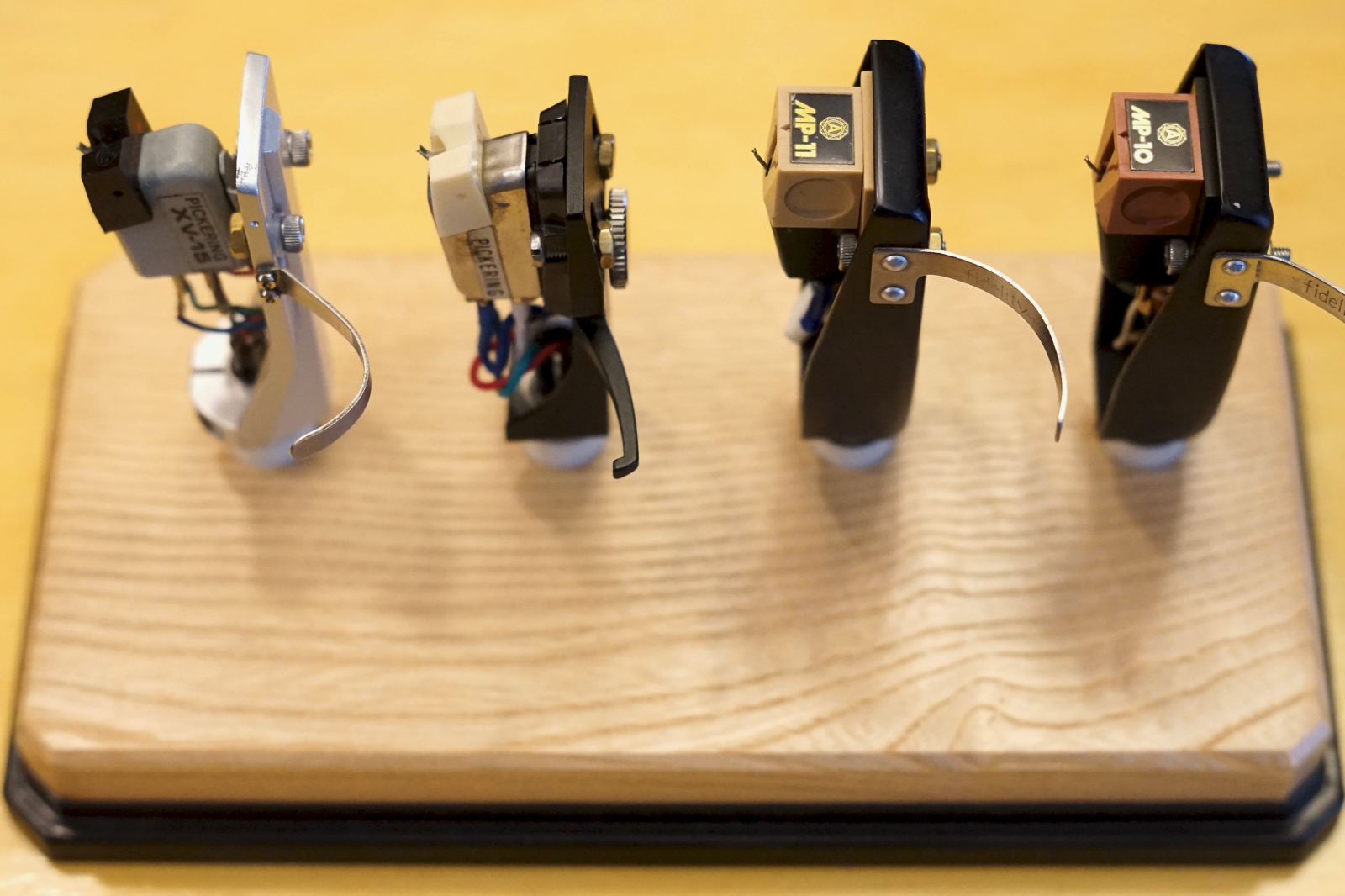
Nagaoka MP11
In the Fall of 1983, my dearly departed dad, a violinist, conductor and music professor, went on an observational tour of orchestras and music schools in the UK under the auspices of the British Council. Before heading back to Manila, he took a side trip to NYC to visit me and see his old haunts. The Nagaoka MP11 pictured above was his gift + a couple of Popular Hi-Fi and Hi-Fi Answers issues he picked up along Tottenham Court Road.
Nagaoka MP11
Mounted on my stock AR XA turntable in '83, I didn't think too highly of the MP11 and preferred the GTE+1. So it rested for more than three decades. When I revisited it, the tables were turned. Listening to the MP11 exposed the Grados' flaws. To my ears, the MP11 is the moving iron equivalent of the Denon DL103R. It has a sweet midrange, detailed and extended in the frequency extremes with a middle row concert hall perspective. Even if the presentation is more relaxed than the Pickering/Stanton models below, it still presents musically satisfying dynamic nuances.
Nagaoka MP110 body + MP10 conical stylus
Encouraged by my rediscovery of the MP11, I kept my eyes peeled for another Nagaoka MP cartridge at close to '80s pricing. Fortunately, I lucked out with a couple of NOS MP10 styli + a cheap MP110 body. I couldn't detect any sonic difference swapping the MP11 or MP10 stylus between the MP11 and MP110 bodies. The DCR of the MP11 coils averaged at ~ 550 ohms while the MP110 ~ 600 ohms. Thus, I assumed that the MP11 and MP110 bodies are identical. Sonically, the MP110 body (or MP11 body) + MP10 stylus = the moving iron equivalent of the Denon DL103.
Pickering/Stanton
Pickering XV15 + D400 conical stylus
The positive attributes I noted about the Pickering 380 + Stanton 371 = Pickering XV15. Compared to the MP10/11, the concert hall perspective is more front row. The midrange is the most three-dimensional in this survey and comparable to the Shure M3/7D. Dynamically, this cartridge is the most exciting in this group.
The MP11/10 beats the XV15 + original conical stylus in terms of detail resolution. Perhaps with an original elliptical stylus, the detail and resolution in the frequency extremes will most likely equal or even surpass the MP11. Note that the Stanton 680 is the same exact cartridge and the stylus are interchangeable between the two bodies.
There's a lot of SPU juiciness from this cartridge!
Pickering V-15 Phase IV + IV AM stylus
The Pickering V-15 Phase IV was designed as the entry-level model in the Flux-Valve (moving iron) line up. I measured an average of 780 ohms DCR from its coils vs. 1200 ohms for its higher-end brother, the XV15.
Its overall performance is formidable and the superiority of the XV15 might only shine through in a direct A/B comparison. The Stanton 600 is the equivalent model.
Sparta 220S
This Sparta 220S cartridge came with one of my Syntec S220 tonearms. The Japanese OEM was identified as a Piezo YM-114 aka Hitachi DS-ST101 by wualta in Audiokarma. It's a very smooth-sounding cartridge with good detail and extension in the frequency extremes. Not as dry as the Grados, but like the 8MZ, it doesn't have the micro/macro dynamic prowess of the Nagaoka MP10/11 and Pickering XV15/Phase IV.
Coda
My Grado cartridge collection survived the '90s purge when I unloaded my two Merrill modified AR turntables, two pairs of Quad ESL57s, a 15 ohm pair of Rogers and a 12 ohm pair of Spendor LS3/5As, a pair of Acrosound TO330 push-pull output transformers, Lafayette KT600, Acrosound 20/20, Dyna ST35, Eico HF87, Leak 20, Pilot SA232, SA260 and many other classic equipment.