
Friday, April 22, 2022

Friday, April 8, 2022
Altec 756B + 32C + 806 + 23744 = mini 757

The WE756A is the middle child in the Western Electric series of wide range drivers introduced in the late 40s.

I've seen and heard a couple of WE/Altec 728Bs + a dozen or so pairs of 755As, but I've never heard a WE756A and have only seen one in the metal at a radio show many years ago. Although still quite scarce, its Altec 756B brother isn't quite as elusive.
 |
| Back: Blonde + Mahogany Altec Melodist 700A Front L-R : WE728B, Altec 755A/pr. + Altec 756B |
Saturday, March 19, 2022
Analog LP Playback + Film Photography
Combining my passion for two obsolete technologies |
| Thorens TD124 MKII with heavy platter + Alfred Bokrand AS309 tonearm Canon P + Canon 50mm f1.8 LTM Ultrafine eXtreme 100 in Kodak HC110 |
Late last year, I acquired the classic AS309 tonearm for my Thorens TD124 MKII from Alfred Bokrand. I really can't hear a difference between the AB309 and AS309, even if I'm forced to split hairs. I'm just happy to own both!
 |
| Garrard 301 + Ortofon RMG309 + SME 3012 in JE Labs plinth Tower 3 (Leica copy) + Leitz Summitar 5cm f2 Ilford FP4+ in Kodak HC110 |
This was my main turntable for over twenty years. Now the duty is shared with the Thorens TD124 MKII above, and the Garrard 401 below.

A couple of blog readers and Instagram contacts have reached out regarding long delivery times from Alfred Bokrand. All of my transactions with him were done through eBay and on the average, delivery was within two months. I highly recommend that buyers order via eBay since it has a buyer protection guarantee.
Thursday, March 3, 2022
emails from Ukraine, was Radiotron SE2A3
 |
| Bach Chaconne from Partita No. 2 in D minor for Solo Violin |
An important lesson I learned as a classically trained violinist was that music theory evolved from the analysis and study of great masterpieces from Bach to Bartok. Great composers broke theory to reach new heights in musical expression. Just like any artistic pursuit, music continues to evolve through individuals who are not afraid to go against convention for a greater good!
 |
| Tube load line simulator from Trioda.com |
On the other hand, audio engineering, for the most part, has always been theory driven. Audio design simulators are significant modern conveniences but don't guarantee musical-sounding circuits even if the metrics look great. Creativity in audio design is when human ears are still the final arbiter, at least in my experience and opinion, which is why my hifi system is a hodgepodge of mostly obsolete technology, some of which date back to almost a century ago.

Last year, a Juilliard-trained pianist turned lawyer visited my man cave and listened to various amps + a couple of speakers I built. On his second visit, he brought his amps for comparison. At the end of that session, he commissioned a pair of Altec 753C speakers, the second pair I built in collaboration with John Piro of Hommage Audio, who crafted the speaker cabinets.

The chosen amp was the Radiotron SE2A3 - a topology from the pre-WWII Radio Designer's Handbook, 3rd edition. This circuit was from an era in which calculators were but a dream and engineers computed complex equations aided by a slide rule.
!!!WARNING!!!
The voltages found in the following circuit can be lethal! Build at your own risk!

Although this pentode-driven circuit sounded fine as is, to my ears, its fullest potential was only realized after I adjusted the plate and screen grid voltages to achieve a 2:1 ratio as suggested by my Ukrainian internet buddy, Sergey Didkovsky in the winter of 2007.
"Try please, to increase the cathode resistor (1,2k-1,5k ohm) and reduce anode resistor (to75k-82k). It will allow to increase Ua up to 150V and to receive Ua:Ug2 = 2:1 ratio. The sound should become more 'interesting and old.' That is especially good for jazz. Still mine 5 cents...use good NOS oil capacitors in G2. I use TCC Visconol. I think oil caps in the grid - adds bass. Reduction of the anode resistor - improves the hi range a little."
 |
| Click here for the 2007 Radiotron SE2A3 article |
I'm pretty sure the 2:1 ratio wasn't a number crunched by a simulator, it was a figure painstakingly chosen by Sergey's ears because of his love for music!

Sergey, wherever you are, I pray that you and your family are safe. Freedom-loving people around the world are very grateful, yet very sorry that Ukraine is all alone in shielding the free world from the atrocities of a megalomaniacal autocrat!

Friday, February 4, 2022
Sony PS1 + Magnavox/Philips NOS TDA1543 CDP Mod
A revival of interest in CDs is imminent, sparked by Pope Francis' recent visit to a mom and pop record store in Rome.😉
 |
| from djmag.com |
Thursday, January 20, 2022
Tuesday, January 4, 2022
Begin the Beguine 2022
A well worn 78 rpm shellac disc of a Cole Porter classic recorded in 1938 by Artie Shaw spinning on a Gray Research HF500 turntable + a GE RPX cartridge amplified by my DIY je2a3 mono integrated fitted with a Hashimoto H203S output transformer driving a GE A1-400 speaker in a "vintage DIY" tuned pipe enclosure by Raymond H. Bates from Audio Magazine May 1955.
 |
| GE "single stud" RPX + 3 mil sapphire stylus in a Karmadon slide shell |

Cheers to 2022! Hopefully, it will be a much better year for all of us!
Tuesday, December 21, 2021
Happy Holidays 2021
With the blessing of Early Bender of Hifitown.com, I uploaded two articles written in the 1980s for The Absolute Sound by his parents, Walt Bender (1944-2008) and Lennice Werth.
 |
| WE/Altec 755A is in Part I |
 |
| Berning EA230 is in Part II |
Olden Golden Components Part II
I've owned quite a few of the components discussed and still listen to a couple. This is a reflection of the articles' profound influence on my pursuit of the audio hobby. Since I believe that they are as relevant then as they are now, I added them to the JE Labs Arkiv.
2021 Index
February: Happy Birthday Mommy + Happy Birthday Daddy
September: DKL and Exacta mount lenses & Exa camera + Budget SUTs - Sony HA-T10 vs. Shure mic transformers
December: JE Labs Man Cave 2021 + Holiday Greetings/2021 Index

As the year comes to a close, I'd like to thank all the visitors, especially those who've contributed to this blog.😊
Wishing everyone a great Holiday Season and all the best in the New Year!
Tuesday, December 7, 2021
man cave 2021

From mid September until mid November, the man cave was out of commission so I set up a temporary system in our living room.

Flooding in the lower level had been a major issue since we moved to this house. Tish and I finally bit the bullet and had a French drain + sump pump system installed.

Knowing that jackhammers would create a big mess, we packed up all of our books, LPs, CDs, etc.

I had to repaint/reseal the floor because it was badly scratched by contractor traffic.

Listening lounge chair

At least 12 square feet of floor space was gained from the removal of a built-in bench. We reclaimed a small window that had been blocked off, which most likely had an a/c in the past.

Monaural hifi view
 |
| Stereo + Monaural Hi-Fi |
Still working on the main hifi system and filing my LPs...😉
I'm really liking the less cluttered look, which means I have to reduce my audio collection. So keep your eyes peeled for goodies at the JE Labs Flea Market after the New Year. 😄
Monday, November 22, 2021
TT Artisan Light Meter
Eleven days after I uploaded my shoe mount light meter article, I took delivery of this light meter from TT Artisan. It came in a nice Japanese-style package!

The light meter requires a 3V CR2032 battery, which is not included due to shipping restrictions. A small screwdriver is supplied for installing the battery + a user manual. The official set up instruction is available on You Tube, so I'll skip those details.

I guesstimate it to be about 15% larger than the Voigtlander VCII.
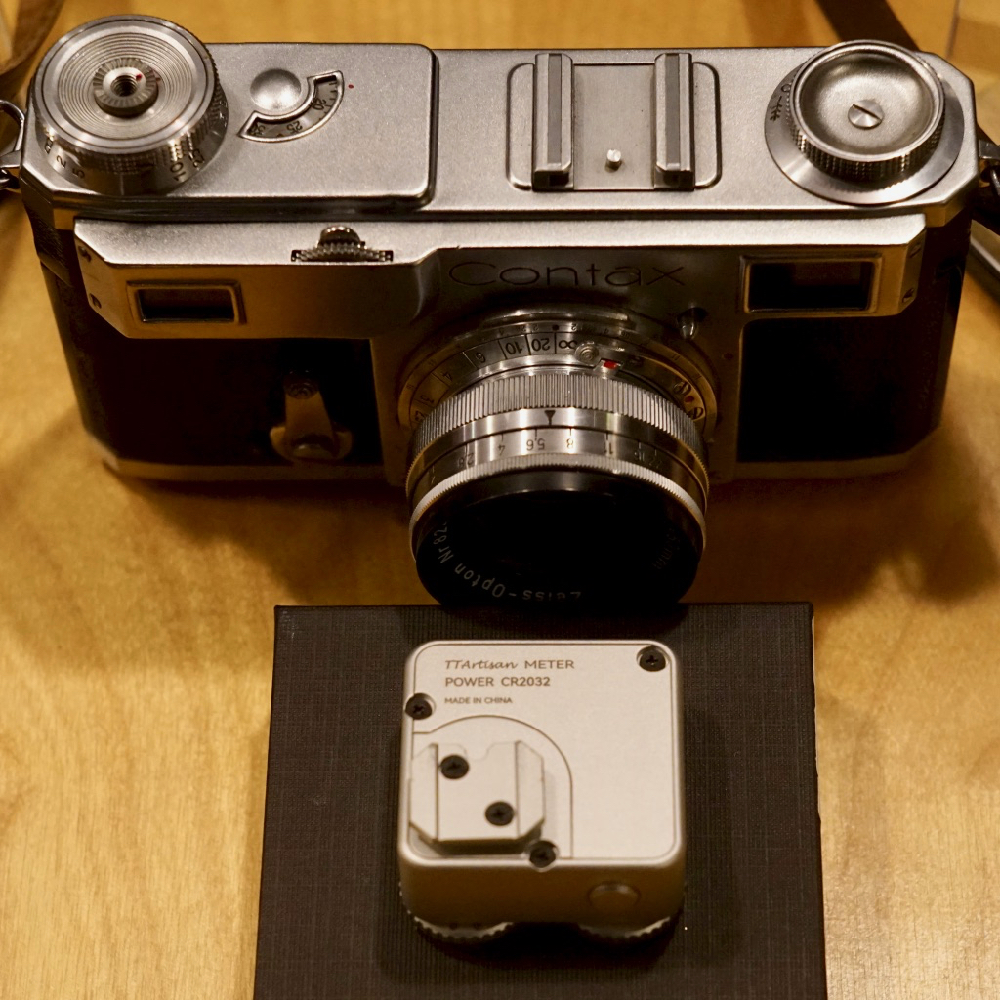
Unlike the VCII, there are no alternative locations for the feet. As is, the light meter didn't clear the rewind knob of my Contax II and clones made in Kiev. A cheap and quick solution is some sort of an accessory shoe that can elevate the meter.

Does it overwhelm a Barnack type body?

Despite the larger dimensions, the dials and markings are smaller than the VCII. Perhaps this only matters to a certain demographic that requires reading glasses, that's why I noticed it. 😉
The TT Artisan has a 45 degree measuring angle vs. the VCII's narrower 30 degrees. This probably accounts for the 1/2 stop difference. Since it’s equipped with a Silicone photodiode, low light sensitivity seems to be as good as the VCII or at least at par with the Vivitar 24.

The Doomo Meter D shares similar technical specs with the Voigtlander VCII, including the svelte proportions of the latter at $125. I snagged my TT Artisan at the introductory price of $56/shipped. The price is now hovering at the $70 mark, but it still is the only shoe-mounted light meter with analog dials available new for under $100.

The Canon P is loaded with ISO 100 film. Watch out for the results in my Flickr!😊
Monday, November 8, 2021
Tube Rolling Fun (and Peril) + Adapters

Tube rolling is a fun aspect of the audio hobby. It only gets tedious when audiophiles start splitting hairs about a VT231, 5692, etc. I draw the line when an audiophool claims, "...my line stage preamp resolves the R train rumble under Carnegie Hall better when I use a 6AS7 in place of the original 6SN7..." 🙄
Those two tubes may be pin compatible BUT a power transformer 🔥melt-down🔥is imminent since the 6AS7/6080 draws 2.5 amps @ 6.3V. That's over 4 times more filament current drawn by a 6SN7, which only draws 0.6 amps @ 6.3V.
💣 💣 💣 Rolling tubes is dangerous unless you have a working knowledge of electronics to comprehend tube data/specs. 💣 💣 💣

It's been a while since I listened through Telefunken 12AX7 smooth plates on an RCA phono. Since I used to graft this circuit on a Dyna PAS preamp, I ordered a pair of 12AU7/12AX7 > 6SN7/6SL7 adapters to relive the experience on my RCA octal preamp.

Back in the 90s, Steve @ Angela Instruments had a boatload of Raytheon 5755s and shared a sleeve with me. Since I never found a project requiring these tubes, I got a pair of 5755/WE420 > 12AX7 adapters to listen to them in the Shure M65 clone. Piggy-backed to 12AX7>6SL7 adapters, they also worked nicely with the octal phono preamp.
Despite slight differences in transconductance and plate impedance between the 6SL7/7F7 and their younger 9-pin siblings (ECC83, 12AD7, 5751 and 5755), there was no visible variation in square waves nor frequency response aberration when I bench tested those tubes in both circuits.

Admittedly, loctals don't look as glamorous as their octal cousins with bakelite bases. But I'm very fond of them to the extent that I built and use a full function loctal preamp. I've been adopting unloved loctals at radio shows and hamfests. Essentially the industrial looking 7F7 and 7N7 are rebased 6SL7 and 6SN7, respectively! My only issue with loctals is, the tube pins are prone to corrosion. This is easily remedied by a wire brush + DeoxIT before use.

I purchased these tube adapters from the seller xulingmrs. They are very well made and fairly priced. Shipping cost and transit time from China was also reasonable. Highly recommended!
Thursday, October 21, 2021
My Collection of Classic Shoe Mount Light Meters

This collection of light sensing gizmos is merely a reflection of the gear head in me since I'm quite proficient with Sunny 16. My dad taught me how to take photos using his unmetered Yashica Penta J. When I see unloved vintage/classic camera paraphernalia for a couple of bucks, I am eager to provide a good home for them. If you want to see my handheld light meters, click here.
Except for the Voigtlãnder VCII, all these light meters employ the match-needle system on an analog dial, which remind me of a slide rule, albeit, circular. For more information, the user manual (when available) is hyperlinked in the text under the picture of each light meter.
 |
Leica Meter 2 |
This selenium light meter doesn't need batteries. The light it is measuring powers the meter. However, selenium isn't as sensitive under low light conditions compared to a battery powered CdS (Cadmium Sulphide) or modern Silicone photodiode. It is smaller but thicker than the Voigtländer VCII and looks great on an early Leica Barnack body.
I paid a couple of bucks for this at an antique store a few decades ago. The selenium cell didn't react to light and the incident light attachment was missing. I sent it to Quality Light Metric and George Milton replaced the dead cell. I consider this more of a collectible than a user, thus, it spends most of its time inside its brown leather case, which prolongs the selenium cell's life.
 |
Gossen Pilot 2 aka Sixtino |
Significantly bigger than the Leica Meter 2 and a tad more sensitive in lower light, this Gossen selenium also measures both incident and reflected light. In my nearly 30 years of scouring Photorama camera shows, thrift stores and flea markets, I've yet to encounter one with a dead cell. This is one of the three I own and this particular unit was recently acquired at a flea market for $7. A bit bulky and just slightly smaller in girth than the Sekonic L-208, it's a nice meter for daylight photo walks. Highly recommended if you want a battery independent light meter!
 |
Kalimar Clip-On |
Not much information can be found about this relatively compact light meter except that which I've already linked. Kalimar was a US distributor of photographic equipment, which sourced cameras and photo accessories from all over the world and had their name stamped on the product.
This CdS light meter requires a PX625 Mercury cell, which is toxic and no longer available. The use of a modern PX625A yielded inconsistent readings. So I hacked a dead PX625 and inserted a 675 sized Wein-cell hearing aid battery into the PX625 shell. Voila! The needle moved when I pressed the button and got readings that were consistent compared to my known light meters. It's also more sensitive in lower light than the selenium meters.
 |
Sekonic Twinmate L-208 |
Sekonic is a Japanese company but the Twinmate L-208 is proudly made in the Philippines. Its Silicon photodiode is powered by a single CR2032 lithium battery and has a light sensitivity range of EV3 - EV17. It is a significant improvement over the above selenium and CdS light meters. Just like all the previous ones, this can measure both reflected and incident light.

Given its size, I think it looks better on a TLR camera. I really like the center match-needle/analog dial ergonomics compared to the $40 digital light meters from China fitted with tiny buttons to navigate around a squinty LCD screen. Is it necessary for every device to resemble a smart phone nowadays?

This CdS meter was designed to be powered by a Mercury 675 battery. Surprisingly, it works great with a modern LR/SR44 without modification. The specified EV range of -1 to 24 maybe a bit optimistic but it's pretty close to the VCII meter in terms of low light sensitivity and accuracy. It has no incident light capability, just reflected light.
Just like the L-208 this is also a center match-needle type light meter with an analog dial that's easy on the eyes and shows other shutter speed/f-stop options. Slightly more compact than the L-208 and sleeker in design. This has become my go-to light meter for photo walks while the Voigtländer VCII takes a rest.
These are easy to find on eBay for $20-30/shipped, which IMO should be the ceiling price. Otherwise, they will be priced out of the market by the minuscule computerized light gadgets from China, which are probably(?) more appealing to hipsters jumping on the analog (film) photography bandwagon.
 |
Voigtländer VCII |
I paid under $200 for this light meter in the mid 2000s and it's still available for $225 from Stephen Gandy at cameraquest.com. Not cheap but in the big scheme of things, it has paid for itself. Its accuracy and sensitivity are probably surpassed only (albeit, slightly) by the built-in meter on my Leica M6. The Si photodiode is powered by two very common LR44/A76/357 batteries and it only measures reflected light. It's not a match-needle type of meter. Instead, it sports a dial for shutter speed and another dial for f-stop/ISO setting + LED indicators. This is an analog design with only a hint of digital (LEDs) and IMHO, MoMA worthy!
Hot on its heels is a new kid on the block, the similarly sized, styled and spec'ed Doomo Meter D at $125. It's ironic that this retro-clone of the VCII is also the most expensive shoe mountable light meter manufactured in China.
Perhaps analog dials and retro tech logic do command and deserve a premium? Hmm...🤔 Right before I clicked the publish button, I noticed something new in the TT Artisan's website. Let's see how that goes...😉
Subscribe to:
Posts (Atom)